Monday, January 30, 2012

The Sidaway Bridge - selected photos from Dec., 2011 and Jan., 2012

Here, I will post at least a dozen photos which I took about one month ago of both people and places directly or indirectly pertaining to the Sidaway Bridge, partly as a picture resource if any technical problems come up with the blog I am still preparing on my visits there of around New Year's Day.....

A few of my views of the bridge had a gloomy sense, a little remindful to me of paintings by Charles Burchfield....

One perhaps obvious basis of this was the bare trees and bushes, giving a pretty clear view at times, as with the north end of the bridge just off of Sidaway Street and Anita Kennedy Drive, where I saw one of a number of plankless stretches:

 
and seeing a mass of tires at the base of its south pier...
 
Additionally, I saw a view of downtown to be had through the overgrowth, to what I assume is the northwest and with the shiny top in the middle distance here that of the Key Tower:
more noticeable just below, where there is also a rough image of part of the RTA (Greater Cleveland Rapid Transit Authority) operations next to its 55th Street Rapid stop, in the middle of the picture at and around the orange-colored line:
From the Rapid line, I also saw a SLIGHTLY clearer view of the Bridge then in August, thanks again partly to bare trees (and once you would enlarge it:)!]....
and from the south and north sides of the Bridge, I saw its arc across its valley....


...met Matt Gute, who lives near 65th a few blocks south of the bridge....
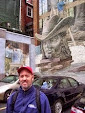
...and reunited with Andre and De'Andre Taylor (left and right, and still perhaps ages 11 and 7 as in August! - though I did not check up on that!), seen here courtesy of both them and their parents, James White and his wife Leslie..
its mural, somewhat visible to the right, above, and more notably here...
and its facade, which I thought had gotten a purple improvement (!) since August:
Ones I saw for the first time included this (1870's?) Italianate House at 3027 E. 65th (above Waterman)....


and this great mixture of a farmhouse?/Mansard suburban dwelling/ (1900-10?) industrial era facade at 2929 65th....

Saturday, January 21, 2012

Returning to the Sidaway Bridge

 Sidaway Bridge, looking towards the north pier, Jan. 2, 2012


In late December and early this month, I went back to the area of the Sidaway Bridge [Please see "A Suspension Bridge in Cleveland", under "September".]  While I was very gratified by a friendly response to what I had written after my visit in August of last year, and found other feedback favoring the bridge, the main bottom line for me - partly because of what I saw at the bottom of the bridge - remains a conditions assessment - IMMEDIATELY, in my advice - to determine the levels of corrosion in this wonderful landmark.

Hopefully, this would buy time for money and community movement to fully renovate and re-open the bridge. That's my dream, certainly, but I am still interested, as I hope every reader here is, with what area residents think - about the bridge and about other histories and sense of place in their midst.

Echoing a positive response

Of the small number of residents and employees I saw in the "bridge area" around New Year's, most were among those who I had met in August of last year. I was glad with their welcome back, including the sense of their sharing my writing with other people who they said were positive about its subject. Luvenia Hardges, for example, on Butler Avenue southwest of the bridge, said "I liked the book", as she referred to my write-up, and that "I showed it to all of the people who came in [to her home]".

At least two people in the area, based on their positive views on the Sidaway bridge, spoke of NOT wanting to loan out the copies which I sent them. One lady joked that if she gave it to a co-worker, she might not give it back, and Greg Wallace, depicted in my September "blog", and seen here near the end of December in his home...

noted friends saying "can you just let me keep it for a little bit?", with Greg responding that no, they should check it out on the internet.

Greg also said he was possessive of the report because "that's my history, that's what I have to give my grandchildren" and this was somewhat echoed by Matt Gute....
 who lives near 65th Street a few blocks south of the bridge and stated that "I want my son to grow up knowing this Cleveland heritage".

"Not the Browns"

Matt, and a friend of his who I'd interviewed in August - Lou (pictured in front of the bridge's south pier in my earlier writing) exuded encouragement on the Sidaway Bridge, but easily criticized one part of a passage expanding on Lou's views from last August, when I said that "a rough parallel" to the idea of moving the bridge was the move in the 1990's of the Cleveland Browns to Baltimore. Matt observed that "it's not the same as the Browns; only because how many people could possibly know about the (bridge)?" and Lou, who is very hospitable, and also very plain-spoken, commented that it was "just a little too strong comparing the bridge with the Browns".


Both of them segued from that into the vision of if it COULD be much more prominent, with me halfway to bemoaning its relative lack of reknown, and also, in retrospect, my likely being wildly inaccurate in how many people know about it; it is embarrassing if honest to write that I told them I guessed "tens of thousands" of people have known about it, but at this point (in late February), I think that that many people may have at least SEEN it, if briefly, during its 45 or more years of being "put out to pasture", and hopefully enough of those (Rapid-based commuters?) could be harnessed to help its cause.


Matt contributed that "it only takes one or two [of the right people] who can take the  bridge's preservation to a higher level, "to where it all touches our hearts [to the level of a major-league Cleveland team]".

Noble and Pathetic

Whereas a big, bad team can languish in full sight, the bridge, when I looked at it from beneath it for the first time, is decaying in a somewhat lonely state, accentuated by windy and snowy weather when I climbed downhill to look at it on Jan. 2. At the same time, its thrust and verticality are impressive, and it is easy to imagine that it can shine again, as here, looking towards the south pier....
and here, including the north pier...
Within that overall dynamic, the tasks to face can easily begin to be seen, most plainly for me in looking straight up at one point:
with a close-up of the above below(!):
and, most seriously perhaps, the possible fire hazard of so many tires at the base of the south pier:
seen here more clearly....
Within the mess and the natural tangle, it is not difficult to see the potential, part of it in the recreational vistas which can be enhanced, as in this view towards the northwest and Cleveland's skyline, even if it is now obscured and you can only see the city's tallest building, the Key Tower, appearing near the center of these two photos, thanks partly to the sunlight bringing it out:
Now, however, like the character of poet Robert Frost who has "miles to go before [he sleeps]", the Sidaway Bridge has many gaps to close before it rises....
view at the beginning of the bridge's north pier, Dec. 30, 2011

Back to the bluffs

Among those gaps, as in my brief talks with people last summer, is one of awareness, at least implied by two new interviewees, both of them employees of neighborhood stores.

At the Kinsman Deli...
on the northeast corner of 70th and Kinsman across from the Heritage View development, Wally Suleiman and a colleague of his said very little about the bridge, in a way that might be summarized as "no news is good news", though again, our quick but friendly discussion left questions as well as answers. Wally's unnamed co-worker said there were "no complaints about the bridge...no problems" and Wally underscored that with the comment that "the people (in the area) complain about security sometimes", but he doesn't "hear anything about the bridge".

In contrast with Wally Suleiman's almost mundane (but welcoming) "checklist" perspective, Kenneth Gregory...

a CSU (Cleveland State University) freshman studying journalism who lived near 55th and Fleet in Slavic Village, was grandiose if not necessarily accurate when I met him on Dec. 31 as he was working in the Q's Stop at 65th and Hoppensack perhaps ten blocks south of the bridge. Like a  few others, he saw the bridge as meant for commuting, and went on to say "not only [economically} but mentally and emotionally as well - that's what bridges do...so we can continue to expand as more than just a person but as a whole; one bridge may open up avenues to many more...."


Even if I privately thought, no, I myself can't see a pedestrian bridge as a "commuting" vehicle (pun intended?), I almost wish there were more people with this rhetoric, as long as it shapes a positive reality, and his words quickly led me to a vision of the bridge (just like new libraries, urban gardens, etc.) bringing one more chance and one more way for people, especially young people, to move up and be successful.

No cars, almost.... 

During this most recent visit, I added a few memories of the bridge to the small set I had written down last August, with a reinforcement of the most impressive and unusual one, from Lou, noted above, when he reminded me, along with his wife Brenda and his mother Helen, of the adventure of his father riding a one-time mini-car known as a King Midget across the bridge.


While I hope to get a good photo in regards to that, at least of the particular model which made the ride (!), I am about to retire to my google abode (ha, ha, or EVERYONE's abode) to pick and give a url for, a likely, and narrow enough, candidate.... Back shortly, I hope....

One of a number of sites, just below, does not do much to show off how catchy a King Midget could be, but notes the width of two models (at 32 and 35 inches, it seems they could have both "taken on" the Sidaway Bridge) and, shows a kind of logo for the Midget Motors Corporation, proudly - for a native Ohioan - based in the town of Athens, perhaps - just guessing here - 150 miles south of Cleveland:
http://www.kingmidgetcarclub.org/junior.html.

Here's a sense of how you could stylize a King Midget: http://www.google.com/imgres?um=1&hl=en&sa=N&biw=1024&bih=629&tbm=isch&tbnid=L4ew0ey-WZ0rdM:&imgrefurl=http://www.jalopyjournal.com/forum/showthread.php%3Ft%3D392352%26showall%3D1&docid=2Xz3nqYEyhRD8M&imgurl=http://www.carnut.com/show/05/mpic/mpic008.jpg&w=750&h=541&ei=xLVFT6zjHYyr0AGElojsAw&zoom=1&iact=hc&vpx=719&vpy=341&dur=6324&hovh=191&hovw=264&tx=103&ty=109&sig=107503107462696977728&page=3&tbnh=149&tbnw=200&start=33&ndsp=19&ved=0CKACEK0DMC8.


More normal movement on the bridge - obviously, for readers of my Sept. 2011 blog, was by foot, and Greg Wallace reinforced that with brief reminiscences of using the bridge to get to movies at the Olympia Theater at 65th and Broadway and other travels such as commuting for jobs, whether of Kinsman residents to the Dan-Dee Potato Chip factory just off of the south end (and factories farther off) or residents from today's Slavic Village to businesses in Kinsman. Greg told me about a barrel factory on Colfax Avenue (a block north of Kinsman) which he thought may have employed 200 people.


That example, which I had not known about, made me think about all the other small or medium-sized places like that which I bet would have existed in the impressive though already declining manufacturing landscape of pre-70's Cleveland. Greg was perhaps pensive about how the U.S. used to make things and "now, we're just consumers" and tried as well to find a photo from his home looking east on Kinsman showing a number of today's vacant lots filled with homes and stores.


Decline, on both sides of the bridge, is a stark reality but coming as well, here from at least Greg Wallace, within the positive frameworks of some reinvestment (if not nearly enough), of clearly happy memories, a commitment to the neighborhood today and of a vote for saving - and re-using - a part of its heritage.

Friday, November 18, 2011

A short walk into history

This afternoon, I went for what is now my shortest "travel" in this blog - about six blocks, from my own tiny interior world here in Center City Philadelphia....
to some great views from the 31st floor of the Hopkinson House at nearby Washington Square, with ones such as this, looking west to the "Center City" skyline, perhaps being the signature images....
but other close-ups and panoramas as well, and a glimpse into the passionate interests of my host high up in the Hopkinson House - Joe Vendetti, an 87-year old native of Philadelphia seen here
who was born and raised in South Philadelphia and has lived near the top of this Center City high-rise for four years now. I met Joe earlier this year, after we had already vaguely known each other as we began to talk in Washington Square about a mutual interest, but much greater for Joe, in one of Philadelphia's greatest citizens - Stephen Girard (1750-1831) - a banking and shipping tycoon and founder of a private school named Girard College to which Joe has become devoted even though he did not attend it, but was inspired to study the school and its founder by a well-remembered and now deceased Girard College graduate for whom he worked in the 1970's and 80's.

Before briefly touching on what is sometimes known here in Philadelphia as "Girardiana", Joe was generous in bringing me back to views I had already seen on an equally clear but warmer day earlier this year, then without my camera, so here's a sampling, from Washington Square just to the north....
Independence Hall's tower two blocks to the northeast....
the restrained "Art Deco" elevations of the N.W,. Ayer Building on the west side of the Square....
and "close-ups" (or what passes with my basic "digital") of landmarks in Joe's Society Hill neighborhood, including children on the playground of the nearby McCall School to the south as school was letting out...
the Mother Bethel Church, an 1889 Romanesque structure with special importance in Black history at the center of this view...
"Old St. Peter's Church" (also near the center, just below), now culminating its 250th year as both an Anglican and Episcopalian congregation....
the Holy Trinity Church immediately to the southeast of the Hopkinson House, including its churchyard where Stephen Girard was once buried (before reinternment at the beautiful "Founders' Hall" of Girard College)....
and the historic Pennsylvania Hospital, a dark part of Girard's life - and more so that of his wife Mary - very close to the southwest of Joe's apartment....


On a wider field, the top of the Hopkinson House and Joe's balcony on its south side afforded a panorama of "South Philly" and "South Jersey", including the Walt Whitman Bridge between Pennsylvania and New Jersey, seen above the center here....
and the bridges and the oil refineries somewhat visible (with enlargement) near the top center of this view.... 

After seeing these cityscapes, I learned a tiny bit about Joe's interests - sometimes transformed into mini-crusades, of which his first and foremost one may have recently been to honor the memory of Mary Lum Girard, whose experience as Stephen Girard's wife may constitute one of the few black marks on his memory.

Girard has been legendized for several reasons, such as his helping Philadelphians during this city's most infamous epidemic - a devastating plague of yellow fever in 1793, when his already solid wealth could have allowed him an easy ticket out of the hot and very sick city that summer. Additionally, Girard has been revered for the huge funds he gave to the nation to fight the War of 1812 and, less than 20 years later, the legacy of his then incredibly large $7 million will, one million of which was given to start Girard College. This private institution, a K-12 boarding school, began life as a shining example of charity and later survived a rough generation when one easily guessable word within the type of students Girard's will would admit - "poor white male orphans" - threw it into a collision course with the Civil Rights movement and a successful quest to open it up to Blacks as well.

Returning to Mary Girard, her noted husband placed her in the mental ward of the Pennsylvania Hospital - I believe in 1786, and despite her returning to good mental health (my account here is not "vetted" with whatever version Joe may have), he kept her there until her death in 1811 (again, if my memory is right). It has often been said that Girard did not let her out because he was unfaithful to her, and Joe today at least commented that "everybody had mistresses in those days", but whatever the verdict on this often charitable millionaire, Joe has deeply believed that the Hospital should remember her in some way.

One of his actions over time has been to stand witness for her outside of PA. Hospital wearing this shirt, seen here along with my placement of an old classic biography of Girard.....
Joe noted with amusement that at least one person responded to this message with "Why would they (PA. Hosp.) refuse pizza?" (as in Tombstone Pizza) and he noted, I'd guess with some pride, that his quest has helped to bring the current executive director of the Hospital to commit to a plaque for Mary Girard, probably being put up at the Hospital in the next year and being paid for by Girard's Class of 1955, also responsible for the plaque noting his aforementioned burial at the Holy Trinity Church (seen above).... 
Joe has also kept Stephen Girard alive in ways including one I had not known to exist, such as following this advice....
with this and I presume other sheets, at a loss, but a gain for the fabulously wealthy banker.....
 
About two years ago, Joe and his daughter had the pleasure of having lunch "across from the Eiffel Tower" with Philippe Girard-Foley, a lawyer and several-times great nephew of Girard who apparently took a 3-hour train ride to Paris to meet them about two years ago. [From a brief look-up here, it appears that Girard-Foley's community of St.Pierre d'Oleron (noted by Joe) is not that far from Girard's native city of Bordeaux, and that his law degrees include one from the University of Pennsylvania here in Philadelphia.(See http://en.wikipedia.org/wiki/Saint-Pierre-d%27Ol%C3%A9ron and
  http://www.linkedin.com/profile/view?id=16050939&authType=NAME_SEARCH&authToken=uTWv&locale=en_US&srchid=eedadb2d-a045-474c-aa21-3976dc6b1f26-0&srchindex=3&srchtotal=3&goback=.fps_PBCK_*1_Philippe_Girard*5Foley_*1_*1_*1_*1_*2_*1_Y_*1_*1_*1_false_1_R_*1_*51_*1_*51_true_*2_*2_*2_*2_*2_*2_*2_*2_*2_*2_*2_*2_*2_*2_*2_*2_*2_*2_*2_*2_*2&pvs=ps&trk=pp_profile_name_link.)]

Joe has been recovering from a stroke but still enjoys life and continues to go beyond Stephen Girard in his pursuits, with another big one being recognition for Italian-Americans interned here in the U.S. during World War II, a kind of step-sister to the much better known imprisonment of Japanese-Americans. Joe brought out the simple graphics of another shirt.....
as well as offering a DVD of a documentary on this lesser-known World War II story and information on a book "Una Storia Segreta" (A Secret Story), subtitled "The Secret History of Italian American Evacuation and Internment During World War II", and written by a California author, Lawrence DiStasi.

Joe offered the basic overview which so many have also concluded that "our government didn't handle it right...they panicked", in regards to confining aliens in general, and remembered his uncle Felix, a shoemaker, who had to carry a resident alien card while his son fought at Guadalcanal, with Joe adding "that's an injustice". Joe himself said that he served in the Army from April 27, 1942 to his discharge on June 9, 1945.

When he began to refer to himself as "we...." my curiosity as to that was partly answered with the rough sense that he does it partly to see himself as helping others with less selfishness or self-centeredness and at one point said "you can see how involved we are...win, lose or draw, you know we tried."  It was hopefully with complete acceptance that he added that "the average person has no interest at all; they think I'm crazy, but that's ok." 

At one point today, Joe asked "am I going to fast for you?" and, knowing I had ostensibly come to photograph the views, said "you got more than you bargained for".