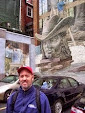
Sunday, August 24, 2014

Randyland: Hard Work and Happiness

On Friday, July 25, I joined thousands of people who have already been uplifted by visits to "Randyland", a joyous spectacle of public art on Pittsburgh's North Side. A superficial look might  just note its weirdness, detachment from general reality and childlike quality, but, in short order, and thanks partly to brief exchanges with its creator, Randy Gilson, I came to see it not just as strange and wonderful but as a reflection of all of the hard work he must have done over the years, and continues to do.

"Randyland" as a subject has definitely been publicized, but I hope that my piece will expose it to other potential "converts", for whom a few photos below will not be enough. [Footnote 1, either at the bottom of this page or the end of this article:) - depending on software:)!] With this partial opening of Randyland, then....
I may be whetting your appetites for a truly three-dimensional experience, both spatial and warmly human, perhaps with the kind of welcome you may be lucky enough to receive from Randy himself.

As I walked from downtown Pittsburgh to Randyland (30 minutes maybe, I recommend it!), I already knew what to expect in part, thanks to the internet and a quick nighttime glance earlier in the week, so given the visual "candyland" of the site, it was subtly appropriate to see this sign along the way, perhaps as discrete and formal as Randyland is bold and casual....
1228 Sherman Street, Mexican War Streets neighborhood

and with hopes its owners will not go all "William Tecumseh Sherman" on me (whoever this home's street is named for, and more on that historical context shortly.]

The sunny delight began as I rounded the corner from Sherman to Jacksonia....
with scenes during my short photo foray including the joyous dance of directional arrows, largely to neighborhood institutions, including Randyland (!)....
the "south elevation" along east-west Jacksonia Street, graced at one point by a mural....
and also by a celebration of 20th-century pop culture, old street signs from the neighborhood, etc., and, around the lower center of this structure, a map of the immediate area....
as well as a proud history of a metropolis known as "Allegheny City", whose boundaries when it briefly rivaled Pittsburgh were much the same as the current "North Side" and which was then swallowed up by its better-known twin city across the (Allegheny) River; that dramatic end, as per the chronology at Randyland, happened on a date which would of course be redolent for American disaster and may have also been one which would live in infamy for "Alleghenians" of the early 1900's....
[Footnote 2]

The east elevation, along the North-South Arch Street, includes, to the left just below, the front of what seemed to be the anchor building of Randyland, and at least its official address of 1501 Arch Street [with its southern elevation already shown above]....
A view from the southeast draws in a little more....
and, in context, looking both ways from the 1500 block of Arch, the neighborhood slopes up to the north, towards another one of Pittsburgh's potential shangri-las (knowing I romanticize in part here)....
and, looking down Arch to the south - at the risk of breaking the schmaltzo-meter - I am betting many children have dreamed of the castle in the distance [otherwise known as the headquarters of Pittsburgh Plate Glass (PPG)]....
The wonderland at hand soon saw its distinctive blonde-haired and glasses-wearing creator drive up, and just as it is easy to now think of him simply as "Randy" and not more formally, it was easy, at least in my case, to secure an interview with him pretty much on the spot, while I did approach him as he got out of his car and with a reference to this blog.

One of the first things Randy Gilson said to me was on what may be the biggest word in his language - "hi" - a word he used at least three times with passersby before an incoming call to him and our sitting down at a picnic table inside Randyland. Randy stated that "[t]hat word is not just a two-letter word, but it's magic", adding that a handshake "can be like an extra exclamation point" and that when you say "'hi' with a smile, it's like a hug".

From then on, his riffs on what inspires him were largely an extension of that warmth and uplift, coupled with a tone of loving encouragement. Sometimes, that might be communicated in unusual phrasings, one example in regards to building your life, when he used a house as a metaphor and said that "the living room is from our parents, the dining room is from our teachers, the kitchen is from our peers." Other philosophies and images were presented in ways I think many people have heard previously in various settings, one statement of his being to "hug your dreams [and] caress your dreams" followed a few seconds later with the statement that "your heart is the key, so love yourself, trust yourself, plant yourself, grow yourself, be yourself".

Even if we might have heard some of this in a self-help/motivational forum, or read it on a card, and even if I might change certain wordings, e.g., "everybody calls me Randyland", I would say that Randy can talk however he wishes, partly because his expressions are coupled with a major work of art and community space, all of it a generous celebration of life.

At the same time as the sense of a bright and shining place - but given just my own brief knowledge and hoping Randy and others will offer their sense - a handful of signs stressing the protection of Randyland, as in the midst of the brimming happiness here along the south elevation....
may speak in a more serious and forceful way to what I began to hear from Randy about his achievements, hard-fought at least for some of them.

Early on he told me he was an "educationally-disabled (ED)" student, something he has turned around with the slogan that "'E' means you have other 'educations' and "D' means you have to be determined".  Logically,  that may have been part of a stew combining the deeply nurturing with a "tough love" approach, including his saying to me that "everytime you look in the mirror... [you should] see if there's something inside that person [to achieve your potential], and that "you should find 365 presents [each year] to unwrap the wonderful creative talents of you" and, additionally, that people who say at the end of a year....

...."'I got nothing done....whine, whine whine' - you should not repeat that (phenomenon) a second time", and that if you are saying "'nothing' today, that means you need to start the 'something' steps".

Randy may be a rare interplay between being truly gentle and having the toughness to blaze creative paths, the latter perhaps reflected in his sharing that "Randyland is definitely a challenge; everyday, I do not want to be a stencil; soon as I'm into tomorrow, I vertical it...people have a hard time changing - I like to challenge myself....."


While conversing here at the aforementioned picnic table....
he said that his project "is the story of a dreamer, just taking baby steps, and planting and gathering and [later] plotting sculptures (and larger components of the site)", and [segueing into a kind of reverie as he did several times during our conversation] "before you know it, you will find the beautiful song of life".

That "all of a sudden" state of progress, as I learned later - and trusting brief pieces of autobiography from Randy - seems to have taken a deep work ethic. In a second impromptu meeting he and I had on July 25, he explained that he has been a waiter at Downtown Pittsburgh's Westin Hotel for 27 years, each year taking at least $4000 in tip money to build 800 gardens, 50 vegetable gardens and eight parks, all in the blocks of the Mexican War Streets, and a huge achievement, even if it includes very small "curb gardens", as well as one of its major plots -  on Veto Street just a little south of Randyland....
Randyland is separate from this "800/50/8" tally, and, as I understand, falls under another statistic from Randy that "a quarter out of every dollar I earn goes to art".

While he embraces all ages, this hard-working adult has spun a child-like paradise including (as just one example) a parade of squeezable plastic rats and nearby dinosaurs....
and I was not surprised that before I met him, I thought of Fred Rogers (Pittsburgh's patron saint for children and neighborliness?), as I saw the affirmation to "believe U can" in the top center of this east elevation exhortation....
During my initial visit, I saw him reaching out to two young people - Katherine and Elizabeth Jenkins, who came in with their aunt Jennifer Marshall, visiting from her job on the North Side, with all of them pictured here after the kids spent time with Randy....
[from the left - Elizabeth Jenkins (age 10), Randy Gilson, Katherine Jenkins (age 8) and Jennifer Marshall]

It was great to see if not note all of the messages Randy animatedly shared with Katherine and Elizabeth, ending with a hug I did not record :)....


and beforehand, his introduction to them included sharing that he only earns "about $20,000 a year", coupling that with advice to not live your life for your money but for being happy, and noting that, not too long ago, "Hollywood found me", in the form of "two guys" who were researching happiness, and have "[considered] me one of the happiest people in America".

One of his later observations referred to kids naturally being smaller than adults, with that being an entree to not let that stop them, reflecting that "what makes you big is when you share what you have with others" and to not wait to be "old, wise people [but] young wise people". Again, as I heard from him, there was the affirming challenge to love yourself, and - another essential step which I had "seen" near the entrance earlier - to "get rid of your worries" and "your angers"....


Later in the day, I saw Randy working with a long-time friend, Mark Guntrum, thanks in part to the success of a recent "Kickstarter" campaign for funds to repaint the neighborhood map along Jacksonia...
and spreading the word (and the love) with visitors Dana Jeffries and Mario Zamora of Portland, Oregon, after just one previous visit to Pittsburgh by Mario but with their coming, as Mario said, completely unexpectedly to the corner of Jacksonia & Arch and being amazed by the artful flowering there....

The day, and a chance meeting with a North Side native, Carl English, suggested - at least for my first visit to Randyland:) - that whatever is negative about Randy Gilson is not so bad and that, like any neighborhood of deep and abiding heritage, I could definitely keep writing about this part of Pittsburgh.

I crossed paths with Carl shortly after I met him at Randy's domain, with his saying jokingly of the artist - "is he done yet?!" and, as we walked south on Arch Street, Carl met up with what seemed to be a few of his many North Side contacts, besides their front porch at a senior housing development - Arch Court - where he genially commented to them "you know Randy don't shut up".

In our short walk, Carl, who is 62, generously took me down to a home occupied by George Ferris (as in the Ferris Wheel)....
and with that, it was easy to think about a "Children's Way", assuming someone may have already strung together enough kid-related sites all the way from Randyland to the Pittsburgh Childrens' Museum, which I later discovered is on a roadway named (or renamed) "Children's Way".

Carl, a proud and lifelong North Sider, said of the changed perceptions of the Mexican War Streets area over recent decades by realtors and others that "they say 'Old Allegheny', 'North Shore'" but "I'm original - It's 'North Side'!" and this is an historic neighborhood!" perhaps his silent exultation below in this view looking north on Arch by the Ferris Home....

In closing, my best wishes to electrician and handyman Carl English, artist and inspirational speaker Randy Gilson, and all of their North Side neighbors.

****************************************
Footnotes

[My apologies for a continuing issue in my footnotes and/or "blogger.com" of "urls" (web addresses) not being "hyperlinked", but with the relative ease of cutting and pasting them in search engines if you want to explore further....]

1. One reassuring element may have come on the same day I saw this colorful work-in-progress, when I was at a more traditional "North Side" landmark, Max's Allegheny Tavern, after lunch with one of my Pittsburgh (-area) nephews (both of them regional natives) (!).  In talking with two other patrons who were natives and still residents of the North Side I was eager to share my visit to Randy Gilson's world while at the same time hesitant to "spoil" their interest with photos, but went ahead with a short show after my Max's waitress said that "pictures don't do it justice".

2. A brief survey on the internet showed a source which attested to Dec. 7 as the date Allegheny City died (http://www.alleghenycity.org/index.php?ARTICLE=2)  and two which state Dec. 9 (http://www.post-gazette.com/local/city/2007/12/09/The-day-the-City-of-Allegheny-disappeared/stories/200712090229 and  https://networks.h-net.org/node/19397/reviews/20681/cialdella-rooney-and-peterson-allegheny-city-history-pittsburghs-north), but whether or not 12/7/1907 was Allegheny City's "Waterloo", it's time to return to another war you may have been wondering about just above, before rejoining the sweetness and light of Randyland, so, briefly...

The Mexican-American War is at least somewhat distasteful depending on one's view of the belief in America's "Manifest Destiny" to overtake (Northern Mexico, in this case!), but considering it as a fait accompli, it is a charming quirk of geography as well as reflecting the bursting pride of the Victorian U.S to have named a few streets in Anglo-America after Mexican venues, largely of victories against Mexico (e.g, streets very close to Randyland such as Resaca, Palo Alto, etc.).


Acknowledgements

My thanks here for use of quotations go to Jennifer Marshall, her nieces Katherine and Elizabeth Jenkins and their parents Todd and Patti. I wish Katherine well in her stated possibilities of becoming a nurse, teacher or hairstylist and Elizabeth the same in her thinking of art or chemistry in her future!


And final words from Randy Gilson, using guitar lessons as an example for a more general point....

"Most people, they take a challenge, and instead of making it simple, they decide all the difficulties, and the difficulties take away the pleasure of the dream....Pick it up, and just strum it; don't think about  all the work, just think about the hand dancing over top of the strings, the music filling your heart with a smile...."
Randy Gilson at "Randyland", July 25, 2014


Thursday, July 10, 2014

A mural dedication today in Philadelphia

[This blog was written July 10, 2014 with the exception of a modified source section at the end - js]

Earlier today, I rode my bike up from the Center City Philadelphia area to the nearby neighborhood of East Kensington to attend the formal debut of a new mural which joins thousands completed under this city's Mural Arts Program.  It was a moving event, featuring as it did a beautiful painting depicting two Philadelphia firemen who died on April 9, 2012 in a large blaze of a 19th-century structure which had housed the one-time Buck Hosiery Company.

The main ceremony involved several speakers, including Jane Golden, the intense and dynamic head of the city's Mural Arts Program (in case out-of-towners are reading this:)), Phila. artists David McShane, Jesse Gardner, and Kien Nguyen (mural collaborators here), seen just below (from L to R at the podium) with Jesse Gardner speaking....
the wife of Commander Robert Neary, one of the fallen firemen, and the parents of Daniel Sweeney, the other fireman who died in the Buck tragedy.

Following stirring bagpipe music, the speeches, and other components, including the quiet repeated ringing of a fire bell, a number of attendees followed the bag-piping band for two blocks, as seen here....
looking west on Arizona towards Jasper Street

to lay two wreaths next to the now-empty lot where the Buck factory once stood....
looking northwest from the corner of Jasper & York Streets, with a "Market-Frankford" El train riding north in the background

After walking back, with scenes of the mural greeting you along part of the route....
I spent time with guests who enjoyed the "Unsung Heroes" Gallery....
where Jesse Gardner shows several of the works which are part of an ungoing project since the early 90's, when he began a passionate mission to honor unheralded firefighters, including minorities and women. Roughly halfway through his "Unsung..." project so far, the attacks of September 11, 2001 highlighted firefighters in an unprecedented way, one example in Gardner's work being a portrait of New York City fire lieutenant Dennis Mojica, who died in his response to the events at the World Trade Center that day and is seen here in close-up...
The Gallery is part of a former industrial building which hosts the mural, and where Jesse Gardner works as a painter and interior designer, and the reception there today was a very friendly affair, made up in part of quiet conversation, sandwiches provided for donations (or not, as we wished) by a Philadelphia Fire Department family association, and ice cream scooped out for free by "Little Baby's", perhaps the most successful new Ice Cream entrepreneur locally in recent years, and seen here after its offerings reached the "empty" stage....
While at the gathering, I had the pleasure of meeting Jesse Gardner, seen here in front of paintings he had done of Robert Neary (to the left) and Daniel Sweeney, with those works being bases for David McShane and Kien Nguyen, the lead artists for the Mural program of today's new mural.....
Additionally, my thanks go out to Joe Rosato, a theater and tech services professional who shares office space at the building with Jesse and who greeted today's visitors with a circuit of photos he had taken during and after the "Buck Hosiery" fire, including two just below.

Undoubtedly, Joe's two images here are among thousands which document the losses of so many buildings which were part of Philadelphia's immense role in American industry, while some nearby one-time industrial structures such as the one occupied by Jesse Gardner are being saved as East Kensington experiences a revival....


[Here is further information regarding Jesse Gardner, with the caution once again that urls here would need to be cut and pasted.

On Gardner, courtesy of "Mural Arts" and a site for his studio and work overall: 
https://www.muralarts.org/artist/jesse-gardner/ 
--and--
http://www.jessejgardnerstudio.com,

....and, for map lovers in part, here is a url for the studio address of 2020 East Arizona Street in East Kensington....
https://www.google.com/maps/place/2020+E+Arizona+St,+Philadelphia,+PA+19125/@39.9836349,-75.1326287,17z/data=!3m1!4b1!4m5!3m4!1s0x89c6c83d689531db:0xe4316f9891bd033c!8m2!3d39.9836349!4d-75.13044

-- JS/July 2, 2017]

Monday, December 30, 2013

"Down in the Dump" below the Sidaway Bridge...

[First-time readers on Cleveland, Ohio's Sidaway Suspension Bridge are directed to my earlier articles on this website, from both 2011 and 2012.]

This long-postponed blog is in memoriam to Larry Lindsey, one of several "bridge-area" residents who I have had the pleasure of meeting since August, 2011. He is pictured here during our sole meeting, on Monday, April 9, 2012, just months before he passed away unexpectedly.
 Larry Lindsey with a part of the Heritage View Homes behind him, on the site of the Garden Valley Projects
 where he spent much of his youth (Monday April 9, 2012)

Whatever my timing, my hope is that the memories of Larry and others will aid in any efforts to revive and re-use the bridge.

I met Larry just after my most sobering time to date in the area of the bridge - during an exploration which I covered a year ago in "Barriers to Preservation - a walk south of the Bridge on April 8, 2012".

His positive recollections happened to largely be geared to the idea of nature in the city which I had already thought of as maybe the major basis on which the bridge can be re-used, and also took me out of the modest emotional "dump" where I had just been - saying that deliberately, as his greatest joy was in recounting time "down in the 'Dump' " - an area for trash lying partly below the bridge during his youth.

On the one hand, a number of the aspects he recollected could be taken as very negative and labeled just as displaying inner-city strife and filth - starting with the City of Cleveland using part of the Kingsbury Run Valley as a trash site, and affirming the sense of division which the bridge came to connote, or, more concretely, how Garden Valley boys would fight with white boys from the south side of the bridge.

A lot of that side of the ledger, though, seemed to be within a warm glow, as one of his major emphases in our short discussion was of the Dump as a "playground" in what sounded like a very nature-filled area, Larry commenting that he was familiar with "every fruit tree down there, apple trees, grape vines, salamanders, strawberry fields, onion fields...I'm telling you, I knew everything that was down there...we had trails all the way down there."


This was punctuated and framed by the literal nature of 2012, as he twice noted seeing a red-tailed hawk as we spoke and added that there were deers downhill from the old Garden Valley area as of much more recent times.

It's likely that this "outstretched" view of him...

came as he said "that was my thing, the Dump," but it definitely was taken as he felt a sense of ownership and happy times.  While I am sorry he is not still here, I'll also remember the feeling he expressed of being "fired up (to explore the Dump)" and I hope that the excitement he felt in April, 2012 for nature and a human landmark is transmitted to others.

***********************

Larry Lindsey was born on March 28, 1954 in Meridian, Mississippi and passed away in Cleveland on Nov. 16, 2012. He grew up in the Garden Valley projects from ages 4-19, served in the United States Air Force, worked as an electrician thereafter and lived in both Euclid, Ohio and the West Side of Cleveland.

His wife Rosa, in a phone call I had with her this past June (of 2013) noted that she grew up in Garden Valley as well, and I want to thank her for letting me add his recollections to this website.

Additionally, my thanks to Allen Norris, seen here near his Heritage View home this past August....

Allen was a friend of Larry when both of them lived in the the Kinsman neighborhood and he introduced me to him in April, 2012.

[Additionally, Larry and I expressed a mutual interest in walking downhill from the bridge when I'd make a future visit, and I pursued that through three cards to him thereafter, with the last one coming after his passing.]

While I may make changes to this blog, it will remain dedicated to Larry.

Tuesday, August 13, 2013

Cheyenne, Wyoming - ready for a second visit!

 On occasional visits to one of my brothers in the Denver area in recent years, we have been fortunate to take day trips out of the city, with the early trend on those sub-journeys being the almost magnetic attraction of the nearby Rocky Mountains, but on my most recent visit in late May, we decided to go to Cheyenne, partly with an interest in cities and its role as a state capitol.

Despite those two "credits" in its favor, my not knowing what to expect was conflated with at least a tiny dose of the underestimation that East and West Coasters can have for "fly-over" country. While Cheyenne is not large as compared with Denver., etc., and this may initially be illustrated with this wide-open space just nine miles south of the city and east of I-25.... 
 
as well as decidely non-dense scenes within the city limits, like this one perhaps two miles southwest of the Capitol building....
looking west on Lincolnway near Cutler

...Cheyenne definitely has the pleasures of old urban aesthetics and actually somewhat of an eastern feel which apparently stems partly from its boom-town days, after it was chosen over then-tiny Denver to gain a prominent spot on the transcontinental railroad as that line's creation was underway in the late 1860's.

That decision is at least one reason that Cheyenne's former Union Pacific Station, dating largely from 1887, is so beautiful....


and that it may have once housed the most important constituent in a city and state built, to a great extent, by the railroad, with it being said that the capitol, seen here....


was designed to face and pay homage to the railroad, housed at the south end of Capitol Avenue....

with the station "looking north" to acknowledge the State, as with the fashionable 1890's lady in the sculpture here in front of the station....

During our short time in Cheyenne, my brother Dan and I paid our respects at the Capitol, including, in part, its atrium....
and a room with paintings of a few of its chief executives, including Governor Nellie Tayloe Ross....
 
who was voted in over an opposing (male) candidate to fill out the remainder of her husband's term after he died in 1924 - not such an anomaly of feminism in a state where women got the right to vote in 1869 - before those of any other territory or state in the post-Civil War decades.(1)

Shortly after seeing the portrait of Governor Ross, Dan and I were about to meet another pioneer of Wyoming politics, as we looked at the House of Representatives' chamber on the east side of the Capitol.....
and began to note its paintings honoring figures from Wyoming's past, such as trappers....
with that elegance overlooking an empty chamber, and, at one of its desks, an open book on ethics; when he saw it Dan said "it looks like someone's working here off-season" and within perhaps a minute, the representative from that desk asked if we wanted to come into the chamber, and we readily accepted.

She was Lynn Hutchings...
and she identified herself as the "first Black conservative Republican" in the state's legislature. Representative Hutchings was a great host for our quick discovery of her working home, talking a little bit about her work, as here just outside the House chamber with Dan....
close to a few of the many photos on Capitol walls of Wyoming representatives and state senators over the years, including James Byrd, another Black representative from the Cheyenne area, of whom she said good-naturedly that "he and I are (as she then made a clashing sound)", and a respectful nod to his mother - H. Elizabeth Byrd, a representative in the 1980's pictured nearby, who was ailing in late May.

Besides her proudly wearing a politically right-wing mantle, and conscious of her race as she noted Whites having said "how dare you vote like you do (with their expecting a left-leaning approach since she is Black)", we did not talk politics as I recall, and certainly not in regards to the liberal and/or moderate ideologies that are a large part of the worldview in our family, but I sensed we might have had a constructive exchange of views and the type of conversation sorely needed in our sometimes way-too divided country.

On a lighter note, Dan and I achieved our life-long dream to dominate Wyoming and its huge tally of electoral votes, with me as the speaker and Dan ably if nepotistically assisting me as ambassador to Colorado....
(or at least basking in the glory of the speaker's platform for the few seconds it took Rep. Hutchings to take our picture!), but - all kidding aside....

Meeting Representative Hutchings was certainly one great part of a quick first visit for me to Wyoming's southeastern corner, and I hope that I will reacquaint myself with the state and its capital in the future.


********************************

(1) "Historic  Walking Tour / Downtown Cheyenne", by Richard Ammon [Cheyenne: Downtown Development Authority, 2011], pp. 27-28; .... 
"Dec 10, 1869:Wyoming grants women the vote" (http://www.history.com/this-day-in-history/wyoming-grants-women-the-vote), which interestingly, says that "[t]hough some men recognized the important role women played in frontier settlement, others voted for women's suffrage only to bolster the strength of conservative voting blocks. In Wyoming, some men were also motivated by sheer loneliness--in 1869, the territory had over 6,000 adult males and only 1,000 females, and area men hoped women would be more likely to settle in the rugged and isolated country if they were granted the right to vote."....
"TODAY IN 1869: WYOMING EXTENDS VOTING RIGHTS TO WOMEN" (http://westlawinsider.com/legal-research/today-in-1869-wyoming-extends-voting-rights-to-women/), which says in part that "when [in 1890 the] U.S. Congress threatened to withhold [Wyoming] statehood over the issue, Wyoming officials responded that [they would rather have the area] remain a territory for 100 years than join the union without women’s suffrage. Congress relented."