[Please see "Sources Consulted" for further information on several subjects below.]
Over seven months ago, as 2014 turned into 2015, I went to South Texas for the first time in my life, and specifically San Antonio. Given that timing, hopefully my present tenses below are still accurate, but in any event....
Knowing abstractly that it meant much more than its most famous landmark, I was very impressed with San Antonio. In an echo of previous blogs, starting with my first one on Hartford, I am sure there is so much more which I can discover on a future visit, whether in its most cliched and powerful monument...
The Alamo, seen on Tuesday, Dec. 30, 2014 in wet weather which Texas needed if tourists may not
or in the city's most famous pathway, seen here on a first enchanted evening there...
the River Walk, or "Paseo del Rio", seen looking east from near North St. Mary's Street Monday night, Dec. 29, 2014
...in a place where I just barely got a sense of routine life, as in this bus stop right above its River Walk....
looking south on North St. Mary's towards Commerce St., Sat morning, Jan. 3, 2015
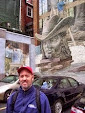
...or its people, with one real one right here, a San Antonian named Ray Zapata, part of a hard-working crew at the hotel where I stayed....
as well as his being a celebrity in every hotel room on the small screen....
and, if a resident of the city of San Antonio, a likely part of a huge Hispanic majority there - 63.2% - in the 2010 census.
I would guess that that statistic is one of the reasons for the rise of the city's recently popular mayor, Julian Castro, who has gone on to serve as the Secretary of Housing and Urban Development in Washington and may become our first Hispanic vice-president or president. Both Castro and post-Castro, the city seems to have offered a lot of beauty and excitement as well as poverty, barriers at times to urban liveliness, and likely growing pains as it continues to rise in the ranks of the biggest cities in the United States.
I was there with other family members, partly to see a relative who had just started a new job in the city, and we stayed in the Drury Inn, located in a former 1920's office building right next to the River Walk, so it was easy to get to know that San Antonio icon. Before coming to the city, I had thought I might not see much of the Walk, being a contrarian when I travel, but for family solidarity, the ease of using it for wandering and just generally falling in love with it, it was a key aspect of my days there. The River Walk seemed like a very popular entertainer (fill in your choice), where people like me might say we won't go along with the herd, but, with such a naturally appealing offering, you can't help but be engaged in it.
The Walk is the result of decades of development and set-backs, based in large part on the turn-of-the-20th-century "City Beautiful" movement. Other factors which brought it to fruition include floods which helped to make the San Antonio River an unsightly ditch at times, and, after a number of years where the Walk was actually fairly unsafe after World War II, becoming a fixture in the city after its international expo "Hemisfair '68", with my guess that it ironically would have removed a lot of aging and potential charm at its grounds, especially for its Tower of the Americas....
looking west from the Institute of Texan Cultures on Fri., Jan 2, 2015
....even as it increased the incentive to "charm up" the city's small-scale heritage along the Walk and elsewhere.
While the walk has been expanded since the 1960's, it maintains significant elements of its pre-World War II fabric, such as this bridge (seen in the night view above)....
looking east towards Navarro Street Bridge over the Walk, Sat., Jan. 3, 2015
dedicated to the guiding spirit behind the Walk - San Antonio-born architect Robert Harvey Harold Hugman (1902-80) as well as a product of the prolific Depression-era Work Projects Administration, as noted in this plaque at the south end of the bridge....
and the overall effort of nearly 100 years now is incredible.
Perhaps the only critique I could offer on this pathway is that there are many stretches, as here a little north of the city's center...
looking south under the Lexington Avenue Bridge, Thurs., Jan 1, 2015
where a railing sure would be nice (!), but it is possible that the pathway's planners deliberately want you to use it with care whether you walk, run, etc.
While I did not cover the whole River Walk network, it does show its rough edges at times, whether in run-down building elevations perhaps waiting for a future investment wave, as in the rusty (fire?) stairways visible on the right side of the building here....
looking south from the Drury Inn dining area, Sat., Jan. 3, 2015
clear urban design failures, as in this parking garage, whose one redeeming feature may be that it curves with the waterway....
looking southeast from south of the Pecan Street Bridge, Thurs., Jan. 1, 2015
...and, if seemingly projecting a standpoint of "pristinity", sterility and classism, it is one of a number of congregating points for the city's large homeless population, while from a more liberal standpoint, they are, from the two dozen or more who I saw, peaceful, friendly and, along with the raggedness of a few adjacent buildings, part of a realness and relative democracy to this corridor.
Well above the Walk and sometimes right next to it, there is a skyline of great height and beauty for the early 20th century, which I had known just a tiny bit about before my visit, focusing mainly on a tower often known as the first air-conditioned office building in the world, the 1921 Milam Building, seen here in a view from the Walk....
looking northwest near the Travis Street Bridge, Thurs., Jan. 1, 2015
Granting it is a major historic landmark in technology, an (irrevocable?) pioneer of a new world lifestyle (and the namesake of perhaps the greatest hero of Texas independence who almost no one has ever heard of - see "Sources consulted")) - what came in my towering San Antonio experience after the Milam is remindful of being introduced to the first sister in a family, finding her reasonably attractive, and then, as the next si(s)blings come walking through the door - man, I did not know how hot this family was! [Very sexist, now Julian will never choose me as his running mate, but as I was saying....]
From the moment I set eyes on her, I fell in love with the Emily Morgan Hotel, which dramatically culminates the East Houston street experience, at least downtown....
looking east on East Houston from east of Presa, Weds., Dec. 31, 2014
reveals a little more of her shapeliness and delicacy close-up....
looking east with the main city post office at the left edge here, Dec. 31, 2014
and coyly appears behind an old live oak at the park around the Alamo just south of it....
looking north near the Alamo, Tues., Dec. 30, 2014
Before the guys get too excited though (man, this is really politically incorrect), here is an astounding one for the ladies, the manly Tower Life Building, one of the first sites of 2015 for me as I turned away from fireworks shortly after midnight....
and in a commanding view as part of it seems to culminate North St. Mary's Street....
looking south near Travis, Thurs., Jan. 1, 2015
Another very appealing high-rise and perhaps one of the sexiest older hospital buildings ever, is the Nix Medical Center. Yes to Nix!!
Here is the side for patients who are stocky but carry it well....
looking south on Navarro from Houston, Sat., Jan. 3, 2015
and here is the south elevation, inviting fitness buffs on the River Walk who aspire to its slimness....
looking north from the River Walk to the west side of the Nix Medical Center's south elevation, Sat., Jan. 3, 2015
Finally, it was interesting to see the following view from north of downtown, where you get an unimpeded "old skyline" view, something far from guaranteed in cities where taller and (sometimes less graceful) office buildings have replaced or at least visually blocked out the pre-World War II ones....
looking south on Broadway from above 9th Street, with the three older skyscrapers from left to right being Tower Life, Nix Medical Center and the Alamo National Bank Building (now the Drury Plaza Hotel). [Tues., Dec. 30, 2014]
The joy I took from these high-rises was actually not consummated in the sense that I did not see if the lobbies in question matched the beauty of the building elevations, except for the small but at times elegant lobby of Nix, with one of its elevators seen here....
Nix Medical Center lobby, second elevator door from the right, Sat., Jan. 3, 2015
....and in case you did not know this was a MEDICAL office tower, an appropriate "Medieval Medical"? symbolization upon it....
segment of the left panel of above elevator door
God willing, I will see the inside of Tower Life, the Alamo Building (which I am told is special), and the Emily Morgan Hotel on a future visit.
The wealth of oil, in part, which produced these towers had its basis in the city's post-Civil War growth as a center for cattle, railroads, flour milling and other fields, which led in a residential sense to perhaps the city's greatest "historic" neighborhood - the King William District, about a mile south of the Alamo.
The "King William" section is glorious in its many wooden houses, some - for lack of photos - a little like larger and wider "shotguns", a few painted in beautiful pastels - and, at the end of a brief ride there - a residential version of New Years' "fireworks" (after real ones two days earlier) - in the late-19th-century homes of King William Street, including the 1876 Steves Mansion....
Villa Finale, also of 1876....
and, an anomaly which suggested the street was still desirable in the inter-war era....
325 King William Street (Fri., Jan. 2, 2015, as with the two photos just above)
[Please see "Sources Consulted" for information on all three of these properties.]
Wealthy patrons here and elsewhere, one can assume, have created a fine museum scene in the city over the years, which I began to see along with family members, and including - between us if not always shared together....
- the fascinating history of Texas ethnic groups in the gapingly unpresentable box housing the Institute of Texan Cultures....
Fri., Jan. 2, 2015
....part of the impressive "plant" of the Witte Museum, directed especially to kids from its beautiful setting in Brackenridge Park on the north side of town....
The Witte's "Body Adventure Pavilion", Friday, Jan. 2, 2015
....the collections of the San Antonio Museum of Art - which I understand from my brother Paul was in a former brewery and has several strengths including pre-Columbian and Asian art, and....
....quite likely the big star for our group, for its great post-1800 art and beautiful surroundings - the McNay Art Museum, with its central courtyard seen here....
looking west into the McNay courtyard, Tues., Dec. 30, 2014
[with the far end including part of the 1927-30 mansion of art collector Marion McNay and her husband Dr. Donald Atkinson, where the museum started in 1954]
The great Impressionist and other treasures of the McNay, the Witte and its surrounding Brackenridge Park....
top: the 1926 Joske Pavilion, a mission-style (stone leopard beauty:)!)
bottom: the Joske Pavilion and a partly visible 1890 iron bridge crossing the San Antonio River beyond it; both seen on Fri., Jan. 2, 2015
...and several other sites, are very much worth a ride up Broadway Street - visible earlier in the "old skyline" view - but a key stretch of this major street, for maybe a mile just above downtown, is dull and largely dead, as here....
looking north on Broadway near 8th Street, Sat., Jan. 3, 2015
followed briefly by a huge freeway interchange which is of course active, but deadening as well, separating what is and what could be to the south from what has sprouted across the freeway - the sometimes hopping (no pun intended?) and definitely growing Pearl Brewery development whose small dome and smokestack are dimly seen here near the right center....
looking northwest from the west side of Broadway north of Roy Smith Road, Thurs., Jan. 1, 2015
and to the left in this photo....
looking north from Roy Smith St. near Avenue B, Sat., Jan. 3, 2015
The Pearl cluster, as it might be called, is evolving as a lively neighborhood of ex-industrial landmarks, including the brewhouse of the one-time Pearl Brewery, with its tower seen near the center of this view....
looking southwest on Karnes from Emma Koehler, Thurs., Jan. 1, 2015
a former stable beautiful in its brickwork and roundness....
looking northeast on Karnes to Emma Koehler, Thurs., Jan. 1, 2015
apartment buildings and restaurants which are largely in spare but attractive modern buildings, including "Green", a great place seen here....
where your "votes" for the restaurant's all-vegetarian lifestyle, likely to be positive ones, join those of more famous people....
perhaps for the fried mushrooms....
[all "Green" photos here taken on Thurs., Jan. 1, 2015]
or other choices.
Whether you eat or drink to San Antonio, perhaps saying aaah! for the so-called "big enchilada" of its "Mexican Modernist" main library...
from North St. Mary's looking north, Thurs., Jan. 1, 2015
take in its present...
looking east on East Houston St. from near the River Walk, Sat., Jan. 3, 2015
or its past...
looking east on Houston from near the R.Walk (in the 1930's, I'm guessing); seen at "Green" Restaurant, Fri., Jan. 2, 2015
I hope your time is as full of enjoyment and the fireworks of urban revelation as mine was....
looking southeast from the roof of the Drury Inn Hotel, shortly after midnight, Jan. 1, 2015, with the Tower of the Americas dimly visible in the left center
Sources consulted
[Some of this may seem dry but hopefully not in regards to the stories of "Emily Morgan", the Pearl Brewery's Emma Koehler and two other Emmas, etc.:).
I hope that in the near future any urls can be hyper-linked and "clickable", but at this point, as with my previous blog citations, you would still need to cut and paste most of them.]
Alamo National Bank Building - This was built in 1929 and reopened as the Drury Plaza Hotel in 2007, as per "Drury Plaza Hotel A Downtown Jewel From Rick Drury and Drury Southwest, at" http://downtownsanantonio.org/main/news/u25.
Drury Inn and Suites (hotel in which I stayed with members of my family) -- "Drury Inn and Suites / San Antonio Riverwalk" (article on its history and renovation), at https://www.druryhotels.com/content/historicalrenovation0005.aspx, which states that it was finished initially in 1921 as the "City Public Service Building" and, sometime after three floors were added in 1927, it became known as the Petroleum Commerce Building. This article also notes that the building was the "first major office building in downtown San Antonio that devoted an architecturally-treated façade to the river"....
Dates are a little different in a pdf for "The Texas Star Trail / A Downtown [SA] Walking Tour", which suggests that the building's opening took place in 1926 and its hotel conversion in 1985. [https://www.saconservation.org/Portals/0/HistoricalTours/texasstartrail.pdf]
The "emilymorgan" writing just above says that the hotel name comes from the story of a "servant girl" who "wooed the Mexican General Santa Anna during the Battle of San Jacinto".
There, her name is stated as Emily West, and elsewhere it is alternately noted that as an indentured servant, she would take the surname of her master - James Morgan [for example, at http://www.tamu.edu/faculty/ccbn/dewitt/adp/archives/yellowrose/yelrose.html ("In Search
of the "Yellow Rose of Texas") OR that she was "erroneously called Emily Morgan by those who presumed her a slave of James Morgan".
[http://www.tshaonline.org/handbook/online/articles/fwe41 {"West, Emily D."}].
Both of these sources suggest that she could be the basis for the legendary song "The Yellow Rose of Texas".
Hemisfair '68 - Sources including "S.A. Back in the Day: HemisFair '68", at http://www.mysanantonio.com/news/local/history-culture/slideshow/S-A-Back-in-the-Day-HemisFair-68-59427.php, which in 50 photos shows a number of fair aspects and partly struck me for its positive pictures regarding the Tower of the Americas along with a few negative ones connected with power failures at the Tower on two occasions during the six-month fair.
Joske Pavilion - "
Doorway Into the Past..../Joske Pavilion", November 4, 2013, at http://doorwayintothepast.blogspot.com/2013/11/joske-pavilion.html; "Native: Joske Pavilion", a brief blog of July 1, 2009 on the website of Rene Balderas, who I have just "met" tonight" (March 9, 2015) and who notes of the Pavilion "
Not only the gem of Brackenridge Park but probably my favorite building in San Antonio by anybody!" [http://www.renejbalderas.com/2009/07/citizen-joske-pavilion.html; Rene Balderas appears to live in the SA area and work as an architecture professor, while his school is not stated, as per https://www.blogger.com/profile/00736658670397984386.]
King William Street (325...) - This "Arte Moderne" house was built in 1940, as per a photo gallery, "Christmastime on King William Street", at http://www.pbase.com/lynnh/image/91030583, within a photo site titled "Historic Texas / Events and Places that celebrate my state's rich history".
McNay Art Museum. "McNay Moments: From Mansion to Museum: The Metamorphosis of Mrs. McNay’s Home". http://www.mcnayart.org/blog/mcnay-moments-from-mansion-to-museum-the-metamorphosis-of-mrs.-mcnays-home
Milam, Ben (1788-1835). Ben Milam is dwarfed in collective Texas memory by Davy Crockett, Sam Houston and others, but his brave and soon-fatal entry into "San Antonio de Bejar" (as it was known in December, 1835) was key in spurring the ultimately successful revolution for Texas's independence from Mexico.
"The Forgotten Hero, Ben Milam", at http://www.texasescapes.com/CFEckhardt/Ben-Milam.htm, includes statements on his grand obscurity such as one which says he is the "only major participant in the Texas Revolution who is never mentioned at all" in "the most comprehensive...novel ever written about Texas, James Michener’s TEXAS".
"MILAM, BENJAMIN RUSH" entry in a digital encyclopedia of the Texas State Historical Association at https://www.tshaonline.org/handbook/online/articles/fmi03 - AS with a number of other sources, this notes Milam's most famous words, "Who will go with old Ben Milam into San Antonio?" inspiring 300 freedom fighters to join him after most members of the army against Mexican rule had decided not to go into the town.
Nix Medical Building - built in 1930, as per http://www.nixhealth.com/home/about-us/mission-and-history?headerbar= which notes of its namesake that, [w]ith few resources available, Joseph M. Nix developed an adventurous concept of a multi-million dollar structure that would house a hospital, physician offices and a parking garage" and "this "medical mall" was the first of its kind in the United States".
Pearl Brewery Brewhouse - A magnificent 1881 structure, which will open shortly as the Hotel Emma within the Kimpton Hotel chain. The "Emma" behind it, who was the wife of Pearl Brewery founder Otto Koehler, became a rare (and very successful) female executive after the murder of her husband by an alleged lover in 1914, as per "The Girl with the Pearl Beering", at http://www.sanantoniomag.com/SAM/January-2011/The-Girl-with-the-Pearl-Beering/.
In March, I briefly read more on this tragedy and a related and occasionally sordid tale of intrigue, libido and more at "Pearl Brewery story is saga of 3 Emmas", a reference to both lovers being known, like Ms. Koehler, as "Emma [See "http://www.houstonchronicle.com/news/columnists/native-texan/article/Pearl-Brewery-rest-of-a-juicy-story-5923317.php, where, if the story disappears - in connection with the Houston Chronicle seeking paying readers:) - you may be able to retrieve if again by googling its title.]
[As per http://www.thehotelemma.com.php53-13.dfw1-1.websitetestlink.com/reservations/, the Hotel Emma should open in October. - 8/5/15]
River Walk -- "SAN ANTONIO RIVER WALK [PASEO DEL RIO]", at http://www.tshaonline.org/handbook/online/articles/hps02 [a project of the Texas State Historical Association]
Population statistics for San Antonio -- "State & County QuickFacts" for the city of San Antonio at http://quickfacts.census.gov/qfd/states/48/4865000.html.
San Antonio - economic history -- "San Antonio History Facts and Timeline" at http://www.world-guides.com/north-america/usa/texas/san-antonio/san_antonio_history.html;
"Aft
er the Civil War, San Antonio prospered as a cattle, distribution, mercantile, and military center serving the border region and the Southwest" from: https://www.tshaonline.org/handbook/online/articles/hds02; "
After the [Civil] war, San Antonio prospered as a center of the cattle culture. Anglo Americans learned the Spanish and Mexican techniques of herding cattle on horseback, creating a new generation of cowboys." [http://en.wikipedia.org/wiki/History_of_San_Antonio];
The city was the southern hub and supplier of the cattle trail drives. An important wool market developed with the importation of merino sheep to the adjacent Hill Country. With the coming of the Galveston, Harrisburg and San Antonio Railway in 1877, San Antonio, formerly without a transportation system, entered a new era of economic growth. -- in "TEXAS LEGENDS
Tower Life Building. A listing for it within the wonderful site emporis.com, at http://www.emporis.com/building/towerlifebuilding-sanantonio-tx-usa, notes that it was finished in 1929 and was ...
- San Antonio's tallest building for 59 years until completion of the Marriott Rivercenter in 1988 [and] [a]lso San Antonio's tallest office building for 60 years until the completion of the Weston Centre in 1989.
The Emporis site was a reminder that one of its previous names was the "Transit Tower", and I believe it was love at first site for me when I saw a picture of it under that name in my (teens? but years ago) in a National Geographic Magazine of around (1940?).
Steves Mansion - The Steves Homestead/House Museum was built for Edward Steves, noted as the founder of the Steves Lumber Company within a brief passage on the mansion at a "Society Properties" segment for its owner, the San Antonio Conservation Society. [See https://www.saconservation.org/OurHistory/PropertiesPurchased/SocietyProperties/tabid/153/ArticleID/32/ArtMID/526/Steves-Homestead---House-Museum-.aspx.]
Villa Finale - According to http://villafinale.org/About.html, this eye-catching museum house, while built for hardware merchant Russel C. Norton in 1876, clearly achieved its Italianate appearance with retardataire timing - in 1904, and it is the only Texas property overseen by the National Trust for Historic Preservation; the Trust "protects and promotes" 27 total historic sites, as per http://www.preservationnation.org/travel-and-sites/sites/.
Work Projects Administration. - This rated as a "look-up" because when I saw the plaque on the River Walk bridge seen above, I thought it might be mistaken, as, like many people, I knew the "WPA" as the Works Progress Administration, but have learned that from 1939-43, it was known as the Work Projects Administration:). See
and


 Historical Tour Guide