Historical Tour Guide
The Coit Tower is one of San Francisco's most famous landmarks, and the story of its colorful benefactress Lillie Coit is easily accessible (Endnote 1) but many people are unaware of its interior murals, and I was one of them prior to my recent visit to San Francisco. In addition, I was struck before I came there to learn that they are highly progressive in terms of a pro-labor spirit, even though these views permeated much of the air in their generation and 1930's "social realist" art. And while that thrust may be the first of the "worlds" I have alluded to above, a second world can be seen within their many details, whether serious, humorous or otherwise.
Upon entry to the Tower, which for most people means buying a ticket for admission to its observation level, the eyes we are seeing above an archway to the tower's elevator foyer have been said to be those of one of the gods of this often ideological art world - Diego Rivera, and while I myself have accepted this as an urban legend, its persistence demonstrates Rivera's spiritual presence in the Tower.....


["Detroit Industry", on the North Wall of the Rivera Court at the Detroit Institute of Arts; source: https://en.wikipedia.org/wiki/File:Rivera_detroit_industry_north.jpg]
While Rivera did not do any of the murals in the tower, his Detroit murals were very recent at the time and were preceded by a mural in 1931 in San Francisco at the San Francisco Art Institute, perhaps under a mile west of the tower. While I was unable to see this work on my SF visit, it honors the working class in terms of people who can generally be seen as "laborers", but also artists working to produce a mural, and is loftily titled ""The Making of a Fresco Showing the Building of a City." [See http://amormundi.blogspot.com/2014/05/san-francisco-art-institute-touts-diego.html for a fine picture of the mural.][Endnote 2 on the Rivera "urban legend" above.]
Almost as soon as I saw these eyes....I began to see what amounted to two dozen details or more over the hours I studied the murals, thanks in part to informative labels; just as the causes which fueled these paintings constitute a kind of "macro" world, the details make up a number of micro-worlds, ranging I'd bet from subtle ones which I do not know to recognitions of the Coit Tower art project and particular artists involved in it, to obvious ones, at least with a little knowledge of 1930's history.
Examples within that last category include the support of 30's "New Deal" programs to restart the economy, workers' rights, etc., and references to concrete realities and ephemera of life 80-85 years ago, such as a showing of Charlie Chaplin's movie "City Lights". A few of the latter, with semi-careful study, might seem as obvious in a way as product placement ads in movies today, while the products at the base of the tower are sometimes the ideas of Communism, Socialism, and the like.
Diagonally across the front hall from the door to the elevator area, there is both a cautionary view of new technology in the 30's such as the building of massive hydroelectric dams, implying their power to environmentally destroy as well as to provide, and at one point, off to the side, the detail of very rich tourists off for a limousine ride in which the poor tent-dwellers nearby are themselves objects of touristic interest....
 The context here includes the struggling family they are observing and a recently-built dam....
 In quick succession thereafter, moving to the left or west, you have workers presenting a strong and somewhat unnerving front as they strike and then scenes including dockside work, certainly a huge part of San Francisco's landscape at the time. Both strikes and shipping, as well as other elements, came together in 1934 in the city's "Maritime and General Strike", the only general strike in the history of the U.S. [Endnote 3].
Turning the corner to the west side of the Tower, the panorama of production there appears very Rivera-esque, at least going on his Detroit murals, with "Industries of California" illustrating packaging and canning....
 While this segment may at once be realistic, repetitive and muted in color beyond the blues in the outfits of female assembly line staffers, another working scene across the base of the tower is both delightfully colorful and idealized as well.
"California Agriculture" IS authentic in depicting an "NRA" stamp on fruit boxes, seen at the lower right here....
 noting support of fair competition under the New Deal's National Recovery Administration, but its first-floor label may or may not be critical in saying that it does not show non-Caucasian farm workers and in perhaps suggesting they were already a sizable part of the farming workforce 80 years ago. Additionally, it is described in the afore-cited architectural guide as showing a "prettified picture of farmworkers" dressed in "romantic garb" and an inaccurate implication of small family farms as a big part of 20th-century California farming [Endnote 4].
In the panorama of "City Life" on the south side of the ground floor, there is at once liveliness and diversion as well as despair and the heartlessness that came at times with the deep economic tragedy of the 1929 crash, as one studies the details in the central portion here....
 To the left of the Tower sales door, you may be able to see both a car crash in the background and an armed robbery in the foreground....
 To the immediate left of the Tower's ticket booth, which itself may play a "news counter", there are the diversions of journalism, ending at the bottom with the sultry actress Mae West, noted in the tower label as a subtle critique of new standards at the time against "indecency" in movies....
 and to the right, you have more "issue-oriented" publications, again in part Communist and Socialist and including the one-time magazine "Masses", just below....[Endnote 5 - I realize this is usually the point at which many people stop reading, but this endnote will be....less "dry", one might say - and pun intended? - so I hope you will cursor down to it:)....]
 Almost exactly across from this side of the "newstand" is a heroically-sized depiction of a "Stockbroker"; on the surface this is a quintessential capitalist, but it turns out that the likely model is someone who in part symbolized help for the little guy in terms of his loans and related acts - Amadeo P. Giannini, the founder of San Francisco's Bank of Italy and then its successor - the Bank of America....
 Along with likely cameos of celebrities in their fields such as this one and a (sly?) insertion of Rivera - setting type at the top center in this scene of "Newsgathering" at the southwest corner of the tower...
 ....there are also a number of depictions of the Tower artists and what are almost advertisements for the Tower mural series, following in part the precedent of self-referential art since that of Medieval cathedral reliefs and Renaissance paintings, but to such an extent that I wondered what caused this profusion, and can only begin to imagine the buoyancy of the setting, where, released to some extent from the trials of unemployment in America's worst depression, even if with just $38 a week as their salary (Endnote 6), free to express their ideologies, with a sizeable youth quotient among them (Endnote 7) and no need to write in long sentences like this one (just kidding!!), but seriously....I can only begin to conclude those were reasons for the confident level of depictions for at least some of the group's players, including (if not as youthful as some), Lucien Labaudt, cleaning cows in "California Industrial Scenes"....
 and John Howard, very close by, "next to" an actual Tower window and peering over silage in one of the trompe l'ceil arrangements of the mural series....
 along with their context....
 Also, however positive, the Tower art effort is presented as part of the ferment of the 30's and what at the time was a very difficult landscape for many Americans and the increasingly dark landscape many observed in the world, in Germany and elsewhere; the news of art coming to the Tower is conflated in the right side of the painting "Library", where there is a headline regarding farm foreclosures in North Dakota (to the lower right), massacres in Austria (top center) and other domestic occurrences some of which reflect contemporary tensions - including the demolition of famous leftist murals by Rivera at Rockefeller Center (announced below the news from Austria)....
 While Coit artist John Langley Howard is shown reaching for a copy of "Das Kapital" in the lower left portion of the "Library" scene above, Clifford Wight, one of the Tower artists fighting rising fascism in the world, really stretched the envelope when given the freedom to work within the three small rectangular spaces seen between the beams and above the west-facing window in the image here....
 While he painted passages titled "New Deal" and "Democracy", he chose for his third and final message to announce "Workers of the World Unite", but also accompanied that with a hammer and sickle, and, in the controversy that followed, all of the images were stripped from their wall spaces, as the first two babies were thrown out along with what was seen as the especially offending Communist bathwater of the "Workers..." passage.
One further inaccurate outflow here was the misleading impression given when this pro-Communist message was shown as having been painted above the "Library" image, as Tower guide Ari Thompson showed me here....
 [source: Coit Tower/San Francisco/Its History and Art, by Masha Zakheim Jewett (SF: Volcano Press, 1983), p. 50; Jewett was the daughter of the artist of "Library", Bernard Zakheim (1896-1985)]
While the trio here was removed from its wall segments, other messages were allowed to remain, even a fist promoting the need for social revolution, above the exit doorway, and visible at https://juliacoynerrobinson.wordpress.com/tag/coit-tower/#jp-carousel-277.
In a more secluded area of both the first and second floors, the temperature definitely moderates - as I culminate this selective Tower art survey - with a series of paintings dealing with the pleasures of contemporary life in the 30's. It is interesting that despite being apolitical, at least on the surface, they are not open to the general public except by an $8 fee per guest, a minimum of 4 guests and a maximum of 8 patrons at a time. [Endnote 8]
My special thanks for seeing them goes to Ari Thompson, Morgan Grimm (a tower manager), his father Terry Grimm, and Hiro, a tower cleaner and guest services staffer.
Perhaps appropriately - given the unseen nature of these paintings for visitors in general, I cannot easily provide my own images of perhaps the most dynamic of these works, having taken a video of it which I may not be able to download here. It is the first segment to be seen as you leave the elevator foyer, and, going through doors to the left of the elevator, wind up a curving staircase to the second floor, where you may be delighted by a view of the life along hill-climbing - and cable-car-famous - Powell Street. Two slivers of these views may be seen in the first and third images just below, and two other view venues are....
https://www.flickr.com/photos/greatestpaka/4449305408/, which offers a partial sense of the left side as one walks up the stairs,
and...
http://blog.sfgate.com/artsandnot/2014/09/30/rare-look-at-7-upstairs-murals-at-coit-tower/#photo-539434, for views 3-7.
At the top of Powell Street, so to speak, there are views of collegiate sports above you and to the left....
 and also straight ahead, "Sports" more broadly, as per the mural title here....

and, to your right, "Children at Play"....Almost as soon as I saw these eyes....I began to see what amounted to two dozen details or more over the hours I studied the murals, thanks in part to informative labels; just as the causes which fueled these paintings constitute a kind of "macro" world, the details make up a number of micro-worlds, ranging I'd bet from subtle ones which I do not know to recognitions of the Coit Tower art project and particular artists involved in it, to obvious ones, at least with a little knowledge of 1930's history.
Examples within that last category include the support of 30's "New Deal" programs to restart the economy, workers' rights, etc., and references to concrete realities and ephemera of life 80-85 years ago, such as a showing of Charlie Chaplin's movie "City Lights". A few of the latter, with semi-careful study, might seem as obvious in a way as product placement ads in movies today, while the products at the base of the tower are sometimes the ideas of Communism, Socialism, and the like.
Diagonally across the front hall from the door to the elevator area, there is both a cautionary view of new technology in the 30's such as the building of massive hydroelectric dams, implying their power to environmentally destroy as well as to provide, and at one point, off to the side, the detail of very rich tourists off for a limousine ride in which the poor tent-dwellers nearby are themselves objects of touristic interest....


Turning the corner to the west side of the Tower, the panorama of production there appears very Rivera-esque, at least going on his Detroit murals, with "Industries of California" illustrating packaging and canning....

"California Agriculture" IS authentic in depicting an "NRA" stamp on fruit boxes, seen at the lower right here....


One further inaccurate outflow here was the misleading impression given when this pro-Communist message was shown as having been painted above the "Library" image, as Tower guide Ari Thompson showed me here....

While the trio here was removed from its wall segments, other messages were allowed to remain, even a fist promoting the need for social revolution, above the exit doorway, and visible at https://juliacoynerrobinson.wordpress.com/tag/coit-tower/#jp-carousel-277.
In a more secluded area of both the first and second floors, the temperature definitely moderates - as I culminate this selective Tower art survey - with a series of paintings dealing with the pleasures of contemporary life in the 30's. It is interesting that despite being apolitical, at least on the surface, they are not open to the general public except by an $8 fee per guest, a minimum of 4 guests and a maximum of 8 patrons at a time. [Endnote 8]
My special thanks for seeing them goes to Ari Thompson, Morgan Grimm (a tower manager), his father Terry Grimm, and Hiro, a tower cleaner and guest services staffer.
Perhaps appropriately - given the unseen nature of these paintings for visitors in general, I cannot easily provide my own images of perhaps the most dynamic of these works, having taken a video of it which I may not be able to download here. It is the first segment to be seen as you leave the elevator foyer, and, going through doors to the left of the elevator, wind up a curving staircase to the second floor, where you may be delighted by a view of the life along hill-climbing - and cable-car-famous - Powell Street. Two slivers of these views may be seen in the first and third images just below, and two other view venues are....
https://www.flickr.com/photos/greatestpaka/4449305408/, which offers a partial sense of the left side as one walks up the stairs,
and...
http://blog.sfgate.com/artsandnot/2014/09/30/rare-look-at-7-upstairs-murals-at-coit-tower/#photo-539434, for views 3-7.
At the top of Powell Street, so to speak, there are views of collegiate sports above you and to the left....


At the end of the second floor, you have images of "Home Life" including a father reading a newspaper as presented by artist Jane Berlandina....


While this beautiful domestic cul-de-sac caps this part of my presentation, I would take my cue from these last two mural pictures, encouraging all of my readers here to "read" these murals further - up close if possible - and/or with a digital house party in your own residence!
My own on-site study party shortly after Christmas could not have been possible without the four people I've noted above, so I hope you'll read more about them as well in the "Acknowledgements" following the endnotes.
Endnotes
1. Lillie Hitchcock Coit (1843-1929) fell in love with the excitement of fighting fires in her adopted city of San Francisco as a girl and - making a long and fascinating story short (or shortening the short version I've been exposed to:)) - her support of local fire companies and the city more broadly led her to leave $125,000 to the city with the general goal of beautifying it.
Remarkably for our perspectives today, that was the Coit Tower's cost, once it was determined as the best use for that amount, according to a brochure I obtained at the tower, with its main title "The Story of Coit Tower And Its Art...." It is undated but gives credit to the San Francisco Recreation and Parks Department.
2. Ari Thompson, a Tower guide, noted in an e-mail to me of Jan. 1, 2016 that the eyes above the entry to the elevator foyer are not those of Rivera, adding that... "[n]ot only did the artist [Ray Boynton] say it was Old Man Weather, but if you look at the image itself, the eyes are surrounded exclusively by weather elements... rain, lightening, moon, sun, and clouds."
3. Randolph Delehanty, San Francisco/Walks and Tours in the Golden Gate City, New York: The Dial Press, 1980, p. 69.
4. I thank Ari Thompson for noting the label text, just below, in an e-mail of Jan. 12, 2016 and her observing, in fairness, that it is not clear if it is referring to non-European-Americans in agriculture of today or of the 1930's....
"In contrast to modern agriculture...the workforce is entirely
European-American, excluding the many agricultural workers of Mexican and Asian descent."
and ibid, p. 70.
5. In reference to subjects such as Mae West, a lascivious element appears at least a few times in these murals, perhaps the most notable one being in a segment on the timber industry, where one is able to see sexual graffiti which may only be delicately alluded to in Randolph Delehanty's guide, where he writes that if you "[l]ook carefully in the mill" you can "find the primitive and communicative roots of all art in a worker's graffito on a pillar" [p. 69]; here is the likely inspiration to which he refers....


It appears that the manly Brown scene and other murals are still happily viewable at the Beach Chalet in Golden Gate Park, as per http://www.atlasobscura.com/places/beach-chalet-wpa-murals.
[On a drier:) but still important note, -- Howard of Brown's firm was the main designer for the Tower.]
6. 2nd panel of the brochure noted in endnote 1 - "The Story of Coit Tower, under the sub-section "The Murals".
7. Examples of younger artists and their Coit contributions include Maxine Albro ("California Agriculture", 1903-1966), Harold Mallette Dean ("Stockbroker", 1907-1975), Edward Terada ("Sports", 1908-1993) and Frede Vidar ("Department Store", 1911-1967).
Sources consulted here, noted after each artist, are, for....
Albro - Tower labels and http://www.sullivangoss.com/maxine_Albro/#Biography
Dean - those labels and http://www.annexgalleries.com/artists/biography/3267/Dean/H.+Mallette
Terada...
https://art.famsf.org/takeo-edward-terada and an excerpt at... Depression-Era Murals of the Bay Area, Nicholas Veronico et al (Charleston, S.C.: Arcadia Publishing Co., 2014) at https://books.google.com/books?id=agwaAwAAQBAJ&pg=PA15&lpg=PA15&dq=Edward+Terada+1908&source=bl&ots=nVc-268O8Y&sig=-ptIiFbT6n-d-ZpB9dH0cKJVskg&hl=en&sa=X&ved=0ahUKEwj41e_WtYnKAhUS22MKHSPiB0QQ6AEIKzAD#v=onepage&q=Edward%20Terada%201908&f=false
Vidar...
https://americangallery.wordpress.com/2010/03/03/frede-vidar-1911-1967/.
8. Initial readers to my blog since Thurs., Jan. 14 would have read that the second-floor paintings are not open to visitors in general "except by a $7 fee per guest and a limit of 6 patrons at a time", as per the 2nd panel of the brochure noted in endnotes 1 & 6, under the sub-section "The Murals", and my improved information above is thanks again to Ari Thompson, from an e-mail to me of Fri., Jan. 15 where she also notes that the San Francisco Art Commission has a limit of 8 visitors at a time on the second floor because of the greater need to protect the artworks there within their narrower stairway and hallway respectively, as compared with the ground level.
The $8 fee per person cited above also includes a guided tour of the first-floor murals. [JS/Jan. 17, 2015]
9. In her e-mail of Jan. 15, mentioned in note 8 just above, Ari adds that in the period between his Tower work and becoming "Brother Buzz", Chesse worked as a puppeteer, primarily in childrens' theater.
Acknowledgements
Grimm, Morgan, and Terry Grimm. Morgan, pictured here in the elevator foyer with parts of the works "Bay Scene" to the right (by Jose Moya del Pino) and "Bay Area Hills" (by Rinaldo Cuneo) to the left....

When I asked Morgan a question he may have gotten hundreds of times, he responded that while he was not related to (a couple of famous authors:)) he said that "my wife's father is Davy Crockett V" and "my side of the family is related to Jesse James" (as per his grandfather) so that, for his daughter, "she's got Davy Crockett and Jesse James".
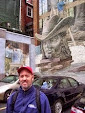
Hiro, seen here in front of the work "Library"...

Thompson, Ari. Ari, seen here next to "Machine Force" by artist Ray Boynton....

She spoke of loving her work at the Tower, largely as a guide, in terms of the "problem-solving of trying to make it a pleasant experience for the people while still trying to protect the art - which is not always easy to do".
Within a varied life which has included being a database manager at UCSF (University of California at San Francisco), working for the San Francisco Symphony and selling bath salts at the city's Pier 39, one consistent element for Ari has been 53 years as a city resident and the last 51 just a block-and-a-half from the Tower.
Thanks to all of these Tower staffers for all of their time on Sat., Dec. 26, 2015 in helping me to better understand a few small layers of the art around them.
Sources
[Abbreviations here include "CT" for Coit Tower]
Austrian violence in 1934 -- noted in my brief research as being part of an Austrian civil war of that year, at http://www.fsmitha.com/h2/ch19vienna.html.
Austrian violence in 1934 -- noted in my brief research as being part of an Austrian civil war of that year, at http://www.fsmitha.com/h2/ch19vienna.html.
Berlandina, Jane (artist of CT murals) http://www.sfgate.com/bayarea/article/Coit-Tower-s-long-hidden-murals-finally-being-5867664.php or "Coit Tower’s long-hidden murals finally being revealed",
and...
and...
Chessé, Ralph (1900-1991) -- http://www.chesseartsltd.com/ralphchesse.html and "Georgia Museum of Art to focus on artist and puppeteer Ralph Chessé" at http://news.uga.edu/releases/article/georgia-museum-art-ralph-chesse/.
For "Children at Play" -- https://livingnewdeal.org/projects/coit-tower-chesse-mural-san-francisco-ca/ and http://www.chesseartsltd.com/wpa-style.html.
Tower manager Terry Grimm felt that the aesthetic of Chesse's work as a puppeteer is reflected in the second-floor images of "Children...."
City Lights (Chaplin film) -- http://www.filmsite.org/city.html and https://www.criterion.com/films/27558-city-lights
Giannini, Amadeo Peter (1870-1949). http://www.pbs.org/wgbh/theymadeamerica/whomade/giannini_hi.html and http://www.biography.com/people/ap-giannini-38693.
Hammer & Sickle image at the Tower...."Coit Tower/Historical Essay" at
http://foundsf.org/index.php?title=Coit_Tower and an essay
"Coit Tower: Part II" at https://juliacoynerrobinson.wordpress.com/tag/coit-tower/
Howard, Henry Temple (1894-1967). http://archives.ced.berkeley.edu/collections/howard-henry-temple,
http://socialarchive.iath.virginia.edu/ark:/99166/w6cm0mzf,
and,
from an excerpt of page 247 of a "National Trust Guide" for San Francisco....
https://books.google.com/books?id=rbAFNxPiVmcC&pg=PA247&lpg=PA247&dq=Henry+Howard+-+architect+-+Coit&source=bl&ots=w6iFkBFYQV&sig=j1j4K_e2b-g8VMqkTdJl_h1q768&hl=en&sa=X&ved=0ahUKEwjalpG57aDKAhXB2R4KHTBPDHI4ChDoAQg3MAI#v=onepage&q=Henry%20Howard%20-%20architect%20-%20Coit&f=false
North Dakota Moratorium. Based on the sub-site "Exhibits - North Dakota Governors - William Langer", at http://history.nd.gov/exhibits/governors/governors17.html, and what I can see in the painting "Library" - N.D. Governor William Langer declared a halt to farm foreclosures in 1934 to help impoverished farmers.
"Powell Street" mural leading to the Tower's second floor; see also http://www.sfgate.com/bayarea/article/Coit-Tower-s-long-hidden-murals-finally-being-5867664.php or
http://www.sfgate.com/bayarea/article/Coit-Tower-s-long-hidden-murals-finally-being-5867664.php or "Coit Tower’s long-hidden murals finally being revealed".
Rivera, Diego (1886-1957) -- Detroit Murals
"Industry and Technology as the Indigenous Culture of Detroit" http://www.dia.org/art/rivera-court.aspx
"Detroit Institute of Arts", a sub-section of "An Analysis of Diego Rivera's Exhibitions in the United States", at
http://www.umich.edu/~ac213/student_projects06/sdtber/Detroit%20institute.html.
Rivera mural at the San Francisco Art Institute
"Diego Rivera Mural" at http://www.sfai.edu/about-sfai/diego-rivera-mural
"Communist Ideology for Capitalist Clients", p. 46 of Diego Rivera, 1886-1957: A Revolutionary Spirit in Modern Art
as reproduced at https://books.google.com/books?id=pvyfaFpm2pgC&pg=PA46&lpg=PA46&dq=rivera+mural+san+francisco+art+institute+1931&source=bl&ots=lPq7N4cqZU&sig=C6XmIWFg2g6UCjQE4nPhUNPrZEA&hl=en&sa=X&ved=0ahUKEwj-k5bBxYHKAhUB6WMKHRPDBDs4ChDoAQhEMAc#v=onepage&q=rivera%20mural%20san%20francisco%20art%20institute%201931&f=false
"San Francisco Art Institute", at http://www.latimes.com/travel/la-trw-sfartinstitute-photo.html
"Diego Rivera: The Making of a Fresco", at http://art-for-a-change.com/blog/2011/12/diego-rivera-the-making-of-a-fresco.html.
Terada, Edward Takeo - his "Sports" mural on the Tower's second floor...
https://livingnewdeal.org/projects/coit-tower-terada-mural-san-francisco-ca/ and https://rkd.nl/en/explore/images/223214.
Zakheim, Masha.
Obituaries at http://www.legacy.com/obituaries/sfgate/obituary.aspx?pid=169782693 and within the website of "Telegraph Hill Dwellers" at http://www.thd.org/2014/coming-events/.
"San Francisco Art Institute", at http://www.latimes.com/travel/la-trw-sfartinstitute-photo.html
"Diego Rivera: The Making of a Fresco", at http://art-for-a-change.com/blog/2011/12/diego-rivera-the-making-of-a-fresco.html.
Terada, Edward Takeo - his "Sports" mural on the Tower's second floor...
https://livingnewdeal.org/projects/coit-tower-terada-mural-san-francisco-ca/ and https://rkd.nl/en/explore/images/223214.
Zakheim, Masha.
Obituaries at http://www.legacy.com/obituaries/sfgate/obituary.aspx?pid=169782693 and within the website of "Telegraph Hill Dwellers" at http://www.thd.org/2014/coming-events/.