Wednesday, March 14, 2012

A few glimpses of devils and friendly people in Ghent

Ghent, Belgium´s famous medieval heritage includes the stereotype of "medieval superstitions", one of them being the legends of devils´ haunts, the most famous one perhaps that of  Gerald the Devil ("Geeraard de Duivelsteen") whose castle, very close to the east end of St. Bavo´s Cathedral and seen in part in the middle distance here....

view looking east on Sint-Baaf´s Plein from east of Lange Kruis Straat, with a wall of St. Bavo´s to the left

was the residence of a medieval nobleman who gained a horrendous reputation, but, according to a lady at one of the local visitors´ centers, was actually a pretty nice person. Hopefully, the public records at his castle benefit from that lightness!

I have not entered this former stronghold, but have spent time on Devil´s Alley, one of whose street signs I discovered just west of my hotel....

but which I at first found to be non-threatening, even bland from one angle....
looking west on Duivelsteeg from Kwaadham

and then pleasant at least on its north side....
where earlier today, after asking three or more people elsewhere, I was glad to meet a lady who identified herself as "Lut" [hopefully... "rhymes with German - or Dutch - for `good´ is `gut´ enough here!], said yes and then no, to a photo, offered a friendly break from cleaning at her house on the alley to say that the name of her passage is said to have come from there being "a lot of prostitutes here" in the Middle Ages, thus also attracting a lot of ladies accused of witchcraft, "so it wasn´t the best place to be" and "that´s the story [but] I don´t know if it´s true.

She added that prostitutes also congregated on the adjacent Kwaadham, and that its name, seen here....

(signs at northwest corner of Kwaadham & Nederpolder)

means "bad ham" - as in "hamstrings", which came from the prostitutes´ frequently opening their legs; for me, this reminder of "bad girls" was juxtaposed with such business in the shadow of St. Bavo´s Cathedral just two blocks or so to the south...
and a street also just off of Kwaadham - no street-sign evidence here, but its name "Ursulinenstraat", connotes the Ursuline nuns, one long-time virtuous group of women.

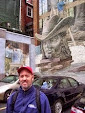
As far as I know, I have not met any "bad girls" in Ghent, but I have easily met some friendly people, enough to give me the impression this IS a welcoming city. These people have included Raymond DeSy ("DIH-SEE" as far as I know) who worked for 44 years for a major regional electric company, especially as a public relations head, and now, is definitely and proudly in public relations for his amazing hometown, where today, I had the good fortune of being directed to him as he was on the steps of the late Gothic/Renaissance "Stad Huis" (City Hall)....

finishing up a little Q & A with Spanish-speaking visitors before going off to meet his wife ("my lady" as he called her) for a drink.
Raymond generously spent the next 20 minutes of more with me, primarily in the darker and earlier (Gothic!) segment you will see above, where I was a little embarrassed, but also very excited, to learn that one of the greatest treaties of American history - the Treaty of Ghent - was finalized on (winging it here, to be honest) - December 24, 1814 - in what is officially known as the Room of Peace...
where Raymond pointed to a 1964 remembrance of that momentous ending to the War of 1812....
(if I assume he knew the famous timing of the Battle of New Orleans weeks after the treaty, but before its news had crossed the Atlantic), and - revealing his sympathies - he expressed the hope that "President Obama" will come in 2014 to celebrate the document´s bicentennial.

Raymond represented bonds of affection in Europe for the United States, largely for older people in relaton to World War II, pointing to another plaque which for him reflected support for the U.S. following the attacks of Sept. 11, 2001, because Sept. 11 was the day 57 years earlier when Allied forces - if specifically Polish, Canadian and British soldiers - liberated Ghent from German control, and he appreciates that on the next day, American soldiers were in the city giving chocolate, meat and cheese to Ghentenaars, after four years of suffering and often starving in the city.

Mr. DeSy also expressed his positive American connections with reference to another local, in volunteering that Norbert DeTaeye, who I had not heard of, is "sponsor for the inundations in New Orleans" (meaning that he is helping victims of Hurricane Katrina), stemming from DeTaeye´s being a gospel musician.

DRAFT


Tuesday, March 13, 2012

Ghent, Belgium - Two of its incredible landmarks

Growing up on a heavy diet of European art history, I began to learn, often in an abstract sense, about how special the city of Ghent is within that area. This past week I felt lucky to attach some buildings, images and names to those claims, and here I´ll give a few highlights of two of the biggest landmarks in this ancient - and very modern Belgian city, with some context, and the disclaimer of confidence that the "gist" if not all of the facts may be right.

Ghent´s phenomenal zenith, when, for example, I understand it grew to become the biggest European city in the 1500´s after Paris and London, was followed by a long decline, which, as with at least a few other cities, helped to save some of its heritage, and when the Industrial Revolution spurred new growth in the 19th century, the town demolished sizeable chunks of the Medieval and Renaissance heritage which may be the city´s main heritage draw today, but in the old town center or nearby created other streetscapes which are great today, such as this one....

looking east on Vlanderen Straat towards Brabantdam

and all of its components, like this 1889 building....

Vlanderenstraat 66 (that´s how they often roll...off the tongue here!)

There are blocks and blocks of lively late 19th-century heritage here, but in this writing, I´ll focus mostly on two highpoints within one block....

St. Bavo´s Cathedral

I honestly do not know how this ranks within a listing of Gothic cathedrals, but it obviously has an impressive space and a rich offering of historic art, and one pinnacle in art history in general.

When I entered the Cathedral, I was moved as I had not been last week at its very rough contemporary of Amsterdam´s "Nieuwe Kerk", and I have quickly realized that one likely reason is that... I didn´t pay a fee of 18 euros (about $24) there to see it and a current exhibit there more fully, but that price also became part of the Nieuwe Kerk´s commercialism, if restrained, and while that Amsterdam monument is next to the "carnival" of the Dam Square, St. Bavo´s front yard, known in Flemish as Sint Baaf´s Plein, is not as much of a draw, attractively so at times, and can even be strangely quiet, as was the case yesterday and at around 5:30pm today, with the Cathedral on its east side....


 At the same time, St. Bavo´s does attract international tourists, and in my two periods there, I heard at least French, Dutch/Flemish (very similar, with the latter a dialect of the former), Spanish, and "American" English. To emphasize that, there are brochures in at least 16 languages for that art history "peak" to which I´ve alluded.

Stepping in to the church through its north transept, one of the first paintings you see is one of its more famous holdings, "Saint Bavo´s Entrance into the Monastery of Ghent", by Peter Paul Rubens....
  While I would get the sense that seasoned travelers might tire of one European Gothic cathedral after another, this one - my first as an adult, was beautiful, as in the south transept....

 and the views to the east end through the choir area....
and to the east end of the sanctuary....
All of this would be enjoyable enough, but, as with other such long-established institutions, later aesthetics were added and have continued to be added, including Baroque glories such as the main altar, constructed from 1705-19 and depicting "Saint Bavo´s Apotheosis"....

and a fairly large amount of stained-glass windows from after 1850, including this one of the mid-1990´s....
one of two windows in Vijd´s Chapel by artist Herman Blondeel done in 1994-96
  
That depiction of the nude woman you may have been looking at at the lower left is Eve, and she is there thanks partly to the "Vijd" of the caption above - Joos Vijd....


 - a wealthy "Gentenaar" (citizen of Ghent), pictured here, along with his separately "paneled" wife, Elisabeth Boorlut...

as part of the "Ghent Altarpiece", whose inside panels, seen at least in a rough approximation here....

have become one of the greatest art works ever, famed for elements I could only begin to show with a ... better camera, but including their realism, detail and brilliant color, and a product finished for the afore-mentioned "Vijd Chapel" in 1432 by brothers Jan and Hubert Van Eyck.

Seeing this legend, protected behind a large glass case in a small room off of the front of St. Bavo´s, was well-worth the 4 euros I believe I paid to see it and pick up a free head-set with explanations set partly to reverent Medieval  music.

The Belfort
...seen from just west of it, with St. Bavo's Church in the right background

The Belfort is a beautiful tower begun in the early 1300's, both to communicate to townspeople through its carillons over the years and to store the most important records for the city. It has come to be one of the most treasured structures of its kind and has been on a UNESCO list of world heritage sites since 1999.

In walking up its more than 230 steps to a glorious viewing area in all four directions, I considered it a place of mystery and anticipation, though the "sense of mystery award" would go on my very short "Ghent" list to a medieval castle known as Gravensteen, once the powerful base for the Counts of Flanders in their fight with proud citizens of Ghent, and seen here....
(from the southeast corner of Burgstraat and Jan Breydel Straat)

Both are thick-walled medieval constructions, with the Belfort very much for the city of Ghent per se, while the Gravensteen was literally outside the city limits at the time of its first use in 1180, and meant to intimidate Ghentenaars into respect for the rulers of their province of Flanders.

At the Belfort, I paid 6 euros (about $8), very much worth the walk up a fairly narrow spiral staircase....
looking into steps from "Tower Keepers" level to Bell Collection area

which led to displays and treasures along the way, including a dragon used as the Belfort's weather vane in the mid-1800's....
what looks like a huge clapper for one of the bells of its past....
 

DRAFT

Wednesday, March 7, 2012

Exploring Amsterdam's center on March 6, 2012

DRAFT
Yesterday, while I saw some grand structures and spaces, I felt as if my walks, in a pretty impromptu fashion (if directed at one point), tended more towards small streets and a few pretty narrow houses, one almost impossibly, and joyously so, if its (inhabitant?) is not clinically depressed.....

Early on in the center, I tried to find out more about the history of the Magna Plaza, seen here in another grand pose at a point I began to see that it might partly be an homage to the onion domes of an exotic east....
  [looking north on the Nieuwezijds Voorburgwal from south of Paleisstraat]

and was unable to get more information from plaques, etc., but aside from too much hipness for me in its fashion and other stores, was completely unsurprised (and happy), to see a grand atrium....
Shortly after that, I went way down in building scale, and probably solidity, but again with pleasure, as I noticed a leaning house, beyond the ones I had already seen, just north of Magna Plaza and just to the right of center here....
[The house in question is at the southeast corner of the Molensteeg  (corrections accepted on this spelling!) and the Spuistraat]

Before the trip, I might have said - don't romanticize, that is TOO quaint, but it looks like a lot of houses in Amsterdam's center are both leaning and loved.

Shortly after turning around the corner of this house, I entered one of many narrow streets in the city and saw a top contender for "narrow house" honors at Molsteegstraat 5....

but as it is obviously muscling out its companions I will post a more flattering view....
As I walked inside the antique store there and at 7 Molsteegstraat, I appreciated the nformation given to me by the owner of both 5 and 7 - Robert Dusarduyn....

who, sitting in #5, noted buying both properties in 1975 and living upstairs from them since then. He said that 5 was "2 metres, 20" in width and 7 was "4 metres, 50" and, when I inquired further, he noted a much narrower house than 5 Molsteeg, just two blocks to the west and then to the right.

Approaching this freak of man-ture, I said "is this it?!! But based on his directions, and it not being 168 Singelgracht ("single canal") to its left, or 170 Singelgracht to its right, it is probably the one and only Singel-ur 166 Singelgracht....
[As to my flipness above, I doubt that the ("inhabitant"?) is going insane, but it takes all kinds of people, I guess!

Just feet away, I got a classic European view towards the monumental "Nieuwe Kerk" of Amsterdam (built just recently in 1485, as opposed to the nearby "Oude Kerk of - the 1300's??***), looking east on the Torensteegstraat from which I'd just come to the Singelgracht....

In further walks, I loved the shapely curve of 170-72 Herengracht ("gentleman's canal" at least gives the gist there) - as the Herengracht curves to the southeast in front of it ...

This grand presence includes the headquarters on its far (south) side of the "Vereniging Hendrick deKeyser" (Hendrick deKeyser Society), an historic preservation organization (yeeaay!! it looks like Amsterdam still needs 'em, like every city, despite its multitudinous blocks of past richness maintained).

My journey soon wound up at the Dam Square, one of a few large open spaces in the center of town, but first, I came again to one of the highest-volume bicycle crossings, very close to Magna Plaza above.....
[looking east on Paleisstraat towards the Nieuwezijds Voorburgwal, the Dam Square and, in the center background, the city's "Koninklijk Paleis" ("Royal Palace")]

Here, and elsewhere, you can definitely see that bicyclists are a huge part of the dynamism of the city, coming perhaps equally at all age levels, if, naturally, more younger than older; they are both casual and intense, but OFTEN intense, and, for me as an American, my greatest danger of injury is absolutely from them, because I am hard-wired, in the U.S., to look for cars, but not for bikers and scooter-riders in their narrow red lanes,  but all-in-all, I hope I have seen the future for many American cities in this aspect.]

I went on to see "tourism central", bustling at Dam Square with human mannequins, such as this man, who wrote down his name as "Costica" [ed. - huh?]....

[but looked more like a combination of Joe Paterno, Elvis and JFK] and other entertainers, clearly vertical as opposed to what is suggested here...
 
  a Madame Tussaud's Museum here on the south side of the square....

and then a more concentrated onslaught of the international economy and both the thin maintenance of sense of place and destruction of that sense, going east on the Nieuwendijk....
[honey, I destroyed the ground floor! Burger King, of course, at Nieuwendijk 218]
[Subway winning an historic preservation prize by comparison, at Nieuwendijk 218]

More soon, I hope, on my sedate night life in Amsterdam.....

***************************************************************
DRAFT

***more on this and other matters perhaps when I'm not paying 1.50euros for the internet, but loving this time at "All in one", Nieuwezijds Voorburgwal 53 (and gracing this blog with a lovely picture soon I hope just below), but for now, picture tourist souvenirs (a dime a dozen in these blocks, two staffers of South Asian descent, but local residents I assume, and two (Russian?) men in their 20's who've been patronizing the internet as well.....  

Tuesday, March 6, 2012

Exploring Amsterdam - a few blocks in the "Oud Zuid" section on March 6, 2012

Today, on the way to some quick shopping at an "Albert Heijn's" (maybe the major "man" on the supermarket block in this country), I had one colorful diversion, and then another one I hope to cover here tonight.

Turning the corner on to a main street known as Amstelveenseweg in the "Oud Zuid""(Old South but not like in the U.S.!) section, I saw a streeetscape somewhat like parts of the North Side of Chicago, as shown here at "Eerste Schinkel Street" looking south....
though making good on that would require a FEW modifications, including subtracting that little red bike lane towards the left, tram tracks, AND Dutch facades. In any event, this is an interesting neighborhood, blessed by the nation's most famous municipal park - the Vondelpark, to its north and seen in small part here....
Shortly after passing this spot, I easily noticed an amazing burst of Swiss chalet-like exuberance in what I learned is appropriately a center geared to kids, but which sounded as if it came from a while before those kids were born....

Buzzing on the doorbell (something you might have to do a lot if in this very friendly, low-crime city), I learned from a staffer there named Erica that this was a tram "remise" - which she understood to be the French term for "garage", but for horse-drawn and not electric trams and a facade design possibly from as early as 1860, by an architect of the surname "Salm". Hopefully this blog will give a more infomative Salm shout-out, but in the meantime, strut your stuff, baby.....


and in context, with a former church now "te huur" (to rent), to the left, and a dance studio to the right....
Erica informed me that besides this building, at Amstelveenseweg 134,  there were two other buildings which were also designed by Salm, one on the first side street to the south (the above-noted Eerste Schinkel Street)....
and another at 27 Schinkelhavenstraat....
Erica noted that (at least) the first and most colorful building was "squatted" in 1984, with my only contribution to that right now being that a huge squatter's movement helped upset an often stodgy Amsterdam "establishment" in the 1970's and 80's and helped, in all of its illegality, to make it the young adult's hive of activity that it is today, and it looks like a courtyard next to the yellow-doored building includes a memorial to that....
where, near the bottom, you can see an inscription for the "binnenpret" organization, which Erica said is the umbrella for several entities including in part the children's center where she works, an alternative music venue, and other organizations, including the "Teatro Munganga", advertised in front of its offices by this colorful truck

and co-founded by Brazilian native Carlos Lagoeiro, seen here with the company's office manager Annemieke Baauw, both of whom very courteously took time away from work in a second-floor office seen behind them to answer some impromptu questions....
Before returning to work in the office, Carlos confirmed Erica's information that this structure (as well as the "yellow..." one) were part of the horse-tram building, and that he thought that the facade for Munganga's office dates from 1893. Annemieke noted that Carlos came to the Netherlands 25 years ago and added that the term "Munganga" relates in large part to "making funny faces", and in a Dutch note posted on a front window at this location, one can at least guess the English meanings of "grimassen (grimace?), danse met grote gebaren (dance with big arms?)...." etc., but a card which she gave me strikes a more mission-oriented note, saying in part that the group focuses on people including the "socially excluded" and wants to raise awareness on respect for each individual, through puppet theater, body language and other means. [See munganga.nl for further information!]

DRAFT

I hope soon to deal with a relatively ancient house for the general Vondelpark area, but for now, it's on to a brief sense of the center of Amsterdam as I experienced it on March 6.  

Acknowledgements

Besides Carlos Lagoeiro and Annemieke Baauw, I wish to echo Annemieke's reference to another "Munganga" co-founder, still active in the theater - Claudia Maoli, while I was not able to meet her in my short visit at Schinkelhaven Straat.